
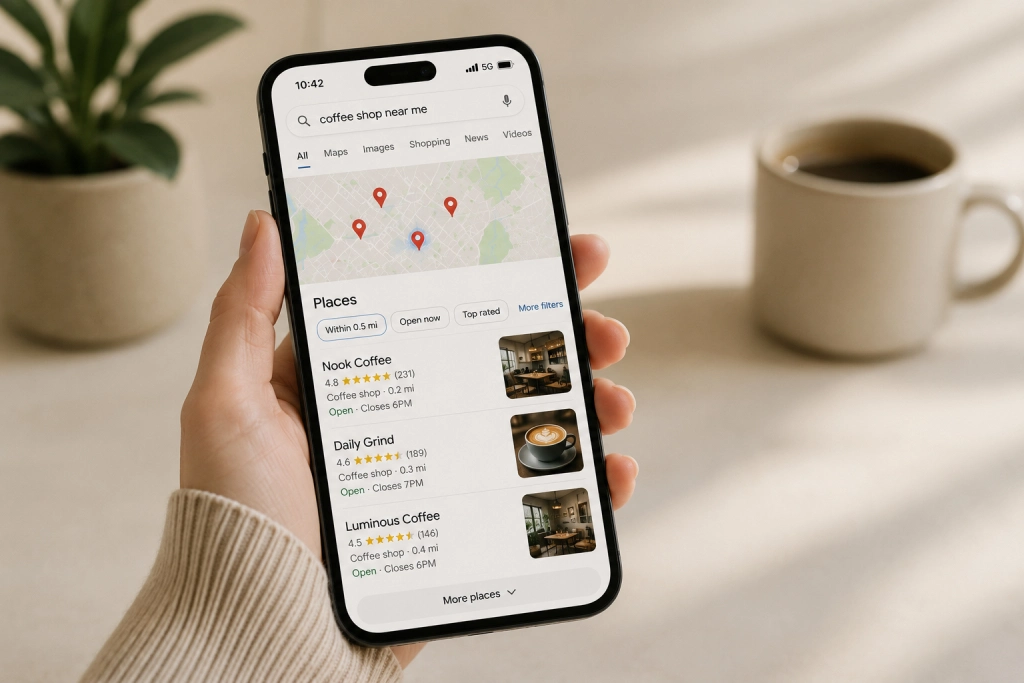
A person who pulls out their phone to find a hardware store nearby is not browsing. They need the closest option that solves their problem right now. Google reads that urgency and matches it to businesses that prove they are local, active, and reliable. A strong near me SEO strategy therefore focuses on the local signals behind those results, which are also central to effective local SEO services.
What Are Near Me Searches?
A near me query is a local search that skips the city name and lets Google figure out where the searcher is standing. The intent is immediate, the device is usually a phone, and the result set leans hard toward map packs and Business Profiles rather than website links.
How Google Infers Location Without a City
Google places a searcher using device GPS, Wi-Fi positioning, Bluetooth, and IP address geolocation. On a phone with GPS, that’s accurate to a few meters. Desktop users without GPS still get a rough location from their IP. That automatic signal means a single word like “pizza” returns a map full of nearby slices, no city name needed.
Implicit vs Explicit Local Intent
A query like “plumber near me” carries implicit local intent; the location is assumed from the device. “Plumber in Denver” carries explicit intent because the city is named, though Google still considers proximity. The practical difference is that implicit queries pull the local pack and maps front and center, while city-named queries often mix in broader results.
Why Near Me Searches Keep Growing
Mobile and voice habits drive the growth. A phone knows where it is, so the city name became redundant, and the search that used to read hardware store Lakewood now reads hardware store near me. Voice pushed it further: nobody speaks a full city and state into a phone when they want a hardware store two blocks away. They say “near me,” because that’s how people talk. Google built for that, and every year the results lean harder toward the map pack that answers it.
Should You Optimize for the Phrase Near Me?
Many site owners burn hours trying to rank for “near me” as a keyword. Google treats the phrase as a location placeholder, so that effort rarely pays off.
Why You Cannot Target Near Me as a Keyword
Google interprets “near me” as local intent and evaluates results partly according to their distance from the searcher. Creating awkward titles, landing pages, or repeated copy solely to target the phrase is unlikely to improve local visibility. Pages that overdo it often read poorly and lose trust. The engine cares about verified location strength, not whether the phrase sits on the page.
What to Optimize Instead
Optimize for the intent. A flooring contractor in Aurora who wants to show up for “flooring contractor near me” needs an accurate Google Business Profile, steady reviews in their service area, and consistent address data everywhere Google looks. Those signals tell Google which geography the business owns, no matter the exact words the searcher types.
| Approach | Why It Falls Short | What Actually Works |
| “Near me” in title tags and H1s | Google infers your location through multiple factors | Set your primary GBP category to the service searched |
| A /service-near-me/ landing page | Every searcher gets a different location substituted in | Optimize the Business Profile; the map pack is the result |
| Tracking a “near me” rank position | The position changes with every searcher’s location | Track map pack visibility across your service area |
| Chasing “near me” search volume | The number lumps together thousands of unrelated local searches | Size demand with the service and city terms underneath |
How Near Me SEO Differs From Standard Local SEO
Near me search engine optimization is not a different playbook. It’s the same local SEO fundamentals with the dial turned up on proximity, mobile signals, and map visibility.
Proximity Carries More Weight Than Keywords
Standard local SEO balances relevance, distance, and prominence. Near-me queries tip that balance. Two Denver electricians with identical reviews and similar profiles will see the closer one win for “electrician near me,” even if the other has stronger on-page copy. Proximity signals like GBP verification, consistent addresses, and correct service-area settings matter more here than keyword placement ever will.
Mobile, Voice, and Maps Change the Result
Near-me searches rarely end at a blue link. Google shows a map pack with three listings, voice assistants speak the winner aloud, and mobile screens push organic results down. Optimizing the Google Business Profile and Apple Maps listing comes first, because those placements answer the query before a website link gets a click.
When to Build City Pages Instead
A business serving several cities gains more from dedicated city pages than from trying to pull near-me traffic onto one generic page. A Denver plumber can build distinct pages for “plumber in Denver,” “plumber in Lakewood,” and “plumber in Centennial.” The way you structure those pages across locations matters. We lay out the full approach for local SEO across multiple locations.
| Signal | Near Me search | City-named search |
| Example | electrician near me | electrician in Boulder |
| What Google uses | The searcher’s live location | The named city |
| Wins on | GBP proximity and reviews | A strong, unique city page |
How to Show Up in Near Me Results
Three signals do the heavy lifting for near-me rankings. Each one makes Google more confident that your business is real, nearby, and worth recommending.
Keep Your Google Business Profile Accurate and Complete
Two fields on your Google Business Profile decide whether you’re eligible for a near-me search at all. Your primary category is what Google matches against the query, which is why an electrician filed under “handyman” loses electrician near me to a competitor with worse reviews and half the photos. Your service area defines the geography you can appear in, and a service-area business that leaves it at a default radius is invisible in half the towns it drives to every week.
Everything else on the profile is hygiene: hours, attributes, photos, secondary categories. Worth doing, and none of it rescues a wrong primary category. Fix the two that gate eligibility, then fill the rest.
Earn Reviews That Signal Local Trust
In a near-me search the map pack is the result. Your star rating and review count sit on the screen next to two competitors before anyone clicks anything, which makes reviews the only ranking signal that also closes the sale. A 4.9 with 200 reviews beats a 5.0 with six, and both of those decisions happen before your website exists to the searcher.
Volume and recency feed the prominence signal Google uses to rank local results. Ask right after the job, while the work is fresh and the customer is standing in it. Reviews that name the neighborhood or the specific job do more than a wall of “great service,” because they tell Google and the reader the same thing: this business works here.
Lock Down NAP Consistency
NAP stands for Name, Address, Phone number. On a near-me query, your address isn’t a trust signal. It’s the point Google measures proximity from. Every other local search gives you room to rank on relevance and prominence. This one starts with a distance calculation, and if that calculation runs from a stale address on an old directory listing, you’re not ranking lower, you’re being measured from the wrong place.
Every directory, social profile, and local citation should carry the identical NAP string. A stale address, disconnected phone number, or duplicate listing can make it harder for Google and customers to identify the correct business information.
Those three levers open the near-me door. Link building, on-page work, and advanced GBP tactics are the next pieces of a full how to do local SEO plan.
Where Near Me Visibility Pays Off
A Denver HVAC company that lands in the top three for “furnace repair near me” fields calls before the office opens, from customers who never scrolled past the map. Electricians in Colorado Springs, roofers in Fort Collins, and retailers with multiple Front Range storefronts see the same pattern. Competitors adjust their profiles, Google refines its algorithm, and rankings drift, so the work doesn’t stop. Unframed handles that ongoing lift for home service businesses across Colorado: keeping profiles accurate, reviews active, and citations clean so near me visibility holds. Reach out to talk through a local SEO plan built around your service area and schedule.
Frequently Asked Questions
Do I Need to Use Near Me Keywords on My Website?
No, you don’t. Google reads “near me” as a proximity trigger and replaces it with the searcher’s location before ranking. Spend your time on accurate location pages, a complete GBP listing, and real customer reviews instead.
What’s the Difference Between Local SEO and Near Me SEO?
Local SEO covers all location-based optimization. Near me SEO is a narrower subset where real-time proximity, mobile signals, and map pack placements carry more weight. Same fundamentals, but near me results reward physical closeness far more heavily than a city-named query does.
Can Service-Area Businesses Rank for Near Me Searches?
Yes. Service-area businesses show up when they define their service boundaries in GBP and verify a legitimate address. Proximity is measured from the customer’s location, not from a storefront, so the same ranking rules still apply.