

Every market your business operates in is its own competition. Ranking well in one city does little for customers searching in the next. Local SEO for multiple locations is the work of earning visibility in every market at once, with a dedicated page and local presence for each one.
Done well, it makes growth predictable, because each new location plugs into a structure that already ranks. This guide covers how to build it.
What Multi-Location SEO Is and Why It Matters
Multi-location SEO is the practice of ranking one brand across many geographic markets, with a dedicated page and local presence for each spot. A plumbing company serving Denver, Boulder, and Fort Collins needs three strong local footprints, one per city. Google reads relevance to the searcher’s location, so the business that matches the city wins visibility.
The stakes are simple. Most local searches end in a real-world action: a call, a visit, a booking. Miss the local result and you hand that customer to the competitor down the street.
Local Search Stats and User Behavior
A complete, accurate profile is what gets a business into the running. Customers lean toward listings that look legitimate and current, and a brand that fills out every field gives them a reason to click.
Behavior matters as much as volume. A person searching for an emergency electrician late on a weeknight has already decided to act. They scan the map pack, tap a number, and book the first credible option. For a multi-location brand, every city page and every profile has to answer fast, with the right hours, the right phone number, and proof you serve that exact area.
How Multi-Location SEO Differs from Single-Location SEO
A single-location business optimizes one page, one Google Business Profile, and one set of citations. Multiply that by every market and the work changes shape entirely.
The hard part is scale without sameness. Each location page needs unique, locally relevant content, yet they all share a brand, a template, and a service list. Copy and paste the Denver page for Boulder and Google sees thin, duplicated content across both. The fix is a repeatable system that produces distinct pages, distinct profiles, and distinct local signals at volume.
Single-location SEO rewards depth on one footprint. With many markets, you earn rankings through consistency first, then layer depth onto each city.
How Google Ranks Multiple Locations
Google ranks local results on three signals: relevance, distance, and prominence. Relevance is how well your page and profile match the query. Distance measures how close your location sits to the searcher. Prominence reflects how known and trusted your business is, drawn from reviews, links, and citations.
For a brand with many branches, each location competes on its own. Your Colorado Springs profile does not lend ranking power to your Fort Collins profile. Both earn their spots independently, which is why per-location optimization beats any single statewide effort.
Proximity has a practical effect. You rarely outrank a well-optimized competitor in a city where you have no physical presence. Want to rank in a market? Put a real, verifiable location there, or build a service-area strategy that Google accepts.
Planning Your Website Structure for Multi-Location SEO
Structure decides how easily Google crawls, understands, and ranks each location. Get the architecture right early and every new market slots into a clean pattern. Botch it, and you spend the next year fixing URLs and untangling duplicate content.
The core question is where your location pages live and how they connect.
Domains, Subdomains, or Subfolders
You have three ways to host location content. Here is how they compare:
| Approach | Example | Best for | Trade-off |
| Subfolders | brand.com/denver | Most multi-location brands | Concentrates authority on one domain |
| Subdomains | denver.brand.com | Large, semi-independent regions | Splits authority across hosts |
| Separate domains | branddenver.com | Distinct brands or franchises | Hardest to build authority for |
Subfolders win for the vast majority of businesses. Every page feeds link equity back to one domain, so a new Greeley page benefits from the authority your whole site already holds.
Reach for subdomains or separate domains only when a location runs as its own brand, like a franchise with independent ownership and a different name. Otherwise you fracture your authority and multiply the upkeep for no ranking gain.
Keyword Strategy for Multi-Location SEO
Keyword strategy for many locations is a distribution problem. The focus here is geo assignment, matching each city to its own page and its own term, so your Lakewood and Aurora pages never compete for the same query.
Standard local keyword research and long-tail local keywords still feed the work. What changes with many locations is the one-city-per-page logic that keeps a large set of pages from working against itself.
Geo-Specific Keyword Research
Start with one proven keyword pattern, then scale it across your full city list. If water heater repair in Denver drives revenue, the same intent exists in Boulder, Aurora, and Fort Collins.
Decide which cities get their own pages by following a clear local keyword research process:
- Begin with the services that already convert.
- Pair each one with every city you serve.
- Check local demand for each pair, and drop the ones no one searches.
Volume varies by market. A search like bankruptcy attorney Denver pulls steady monthly traffic, while the same phrase in a small mountain town like Leadville may pull almost none. Assign pages where demand exists and fold the quiet markets into a regional page instead of spinning up a ghost town.
Avoiding Keyword Cannibalization
Nearby location pages are the usual cause. A metro page and a neighborhood page chase the same query, and Google splits the rankings between them.
The rule that prevents it: one primary keyword, one page, one city. Your Denver page owns the citywide term. A Cherry Creek page, if you build one, takes the neighborhood and links up to Denver as its parent.
Signs of overlap:
- Two location pages swap positions for the same term.
- Impressions split across URLs in Search Console.
- A weaker page outranks the one you meant to win.
Fix it by consolidating, redirecting, or re-scoping the weaker page. One clear owner per query keeps rankings stable.
Keyword Mapping Workflow
For multi-location SEO, the keyword map keeps every page distinct as you scale. It ties each geo term to one URL, so nothing overlaps and nothing gets orphaned, and it stays your single source of truth no matter how many markets you add.
Build it in four columns:
- City: the market the page serves.
- Primary keyword: the one geo term that page must own.
- URL: the exact page assigned to it.
- Secondary terms: supporting variations that live on the same page.
Across the full list, no primary keyword should appear twice. If roofing contractor Aurora shows up against two URLs, you have a cannibalization fix to make before launch.
Update the map every time you add a market. A living map is how a team learns how to rank in multiple cities without tripping over its own pages, even as the site keeps growing.
Creating Optimized Location Pages
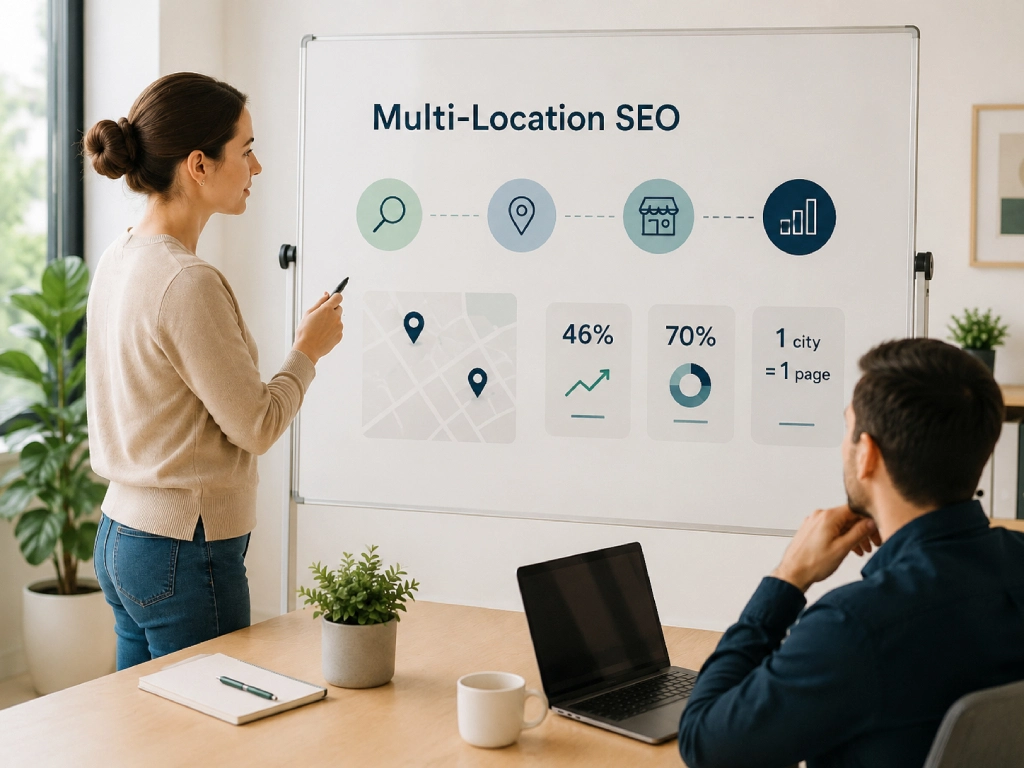
Your location pages do the heavy lifting. They are where a searcher lands, decides you serve their area, and reaches for the phone. A strong location page reads like it was written for one city, because it was.
Three things make these pages work: the right elements, solid on-page SEO, and smart internal links between them.
Essential Elements for Strong Location Pages
Every location page should answer one question on sight. Does this business serve me, and can I trust it? Include these elements:
- NAP block: business name, local address, local phone number, visible and in text.
- Embedded Google map for the exact location.
- City-specific intro that names local landmarks, neighborhoods, or service zones.
- Services offered at that location, with any local specialties called out.
- Local proof: reviews from that market, photos of the real site, the local team.
- LocalBusiness schema with the correct address and geo-coordinates.
- A clear call to action: call, book, or get directions.
Skip the generic stock photos and recycled copy. A page that names the Highlands neighborhood, quotes a real Denver customer, and shows your actual storefront tells Google and the visitor that you belong in that market.
On-Page SEO Best Practices
On-page SEO tells Google exactly what each page covers and which city it serves. Get the basics right on every location page:
- Title tag: primary keyword plus city, kept under about 60 characters, like Roof Repair in Denver followed by your brand name.
- H1: one per page, matching the page’s core term and city.
- URL: clean and consistent, like brand.com/denver/roof-repair.
- Meta description: a direct, specific summary that names the city.
- Body copy: fully unique per location, written for that market.
- Internal links: a few that point to related services and the parent city page.
Consistency across the template matters more than clever variation. Pick one URL pattern, one title format, one heading logic, and apply them everywhere. A predictable structure is how SEO for multi-location business stays manageable as you add the next batch of pages.
Internal Linking Between Location Pages
Internal links pass authority and tell Google how your locations relate. Done well, they turn a pile of separate pages into a connected local network.
Three patterns carry most of the value:
- Hub and spoke: a main Locations page links to every city page, and each city page links back.
- Parent and child: a metro page links down to neighborhood pages, which link up to the metro.
- Service cross-links: a city’s roofing page links to that same city’s gutter page, so the visitor stays in-market.
Anchor text should name the destination and its city, like Boulder roof repair, rather than a generic click-here link. Avoid linking a Denver page to a Colorado Springs service for no reason. Relevance guides every link. A tight internal structure helps Google crawl new locations faster and spreads ranking strength to the pages that need it.
Off-Page SEO for Local Authority
On-page work makes you eligible to rank. Winning the top spot comes from off-page signals Google trusts beyond your own site: Google Business Profiles, citations, and reviews across every market.
At scale, the challenge is keeping all of it accurate and active across dozens of locations at once.
Optimizing Google Business Profiles at Scale
The Google Business Profile is the single biggest local ranking factor for most businesses, and it drives the map pack directly. For one location, optimizing it is an afternoon. For many, you need a system.
Per profile, get the fundamentals right:
- Accurate name, address, and phone, matching your website exactly.
- Correct primary category, plus relevant secondary categories.
- Complete hours, including holidays.
- Photos of the real location, refreshed regularly.
- Products, services, and attributes filled in.
- Posts and updates published on a steady cadence.
At volume, use the Google Business Profile API or a management platform to push updates across locations without logging into each one by hand. A complete profile makes a shopper far more likely to choose you, so the payoff scales with every location you finish.
Citations and NAP Consistency
A citation is any online mention of your business name, address, and phone number, on local business listings like Yelp, Apple Maps, and Bing Places. NAP consistency means that information matches everywhere it appears.
Google cross-checks your details across the web to confirm a location is real. Mismatched addresses or old phone numbers create doubt, and doubt costs rankings. Picture one branch listed as Suite 200 on your site, Ste. 200 on Yelp, and Number 200 on a directory. Small gaps add up to a confused signal.
For multi-location brands:
- Keep a master NAP sheet for every location.
- Push citations through a service like Yext or BrightLocal to stay consistent at scale.
- Audit quarterly for duplicates and outdated entries.
One wrong number on a busy profile routes calls into a dead line, so accuracy here protects real revenue.
Building Review Velocity Across Locations
Review velocity is the pace and steadiness of new reviews a location earns over time. Google favors profiles that collect fresh reviews consistently, so a trickle every week beats a flood once a year.
Across many markets, the goal is a repeatable ask:
- Trigger a review request right after service, by text or email.
- Send customers a direct link to the correct location’s profile.
- Respond to every review, positive or critical, in a local voice.
- Track velocity per location so no market goes quiet.
Reviews shape rankings and conversions at the same time. A profile with dozens of recent reviews and owner replies reads as active and trusted. That lifts the location in the map pack and gives the next caller a reason to pick you over the shop next door.
Common Multi-Location SEO Mistakes (and How to Fix Them)
Most multi-location SEO problems trace back to shortcuts that looked efficient at the time. Here are the ones that quietly tank rankings, and the fix for each.
| Mistake | Fix |
| Duplicate content across cities | Write fully unique copy per market, with real local detail |
| One page targeting many cities | One city per page, one primary keyword each |
| Inconsistent NAP across directories | Keep a master NAP sheet and push consistent citations |
| Ignoring or faking Google Business Profiles | Claim, verify, and optimize every profile |
| No location-specific reviews | Build steady review velocity per location |
| Orphaned location pages with no internal links | Connect them with hub-and-spoke internal links |
| Keyword cannibalization between nearby pages | One owner per query, enforced in your keyword map |
Work down the list against your own site. Each fix maps to a section above, so you move from diagnosis to repair fast.
Scaling Multi-Location SEO
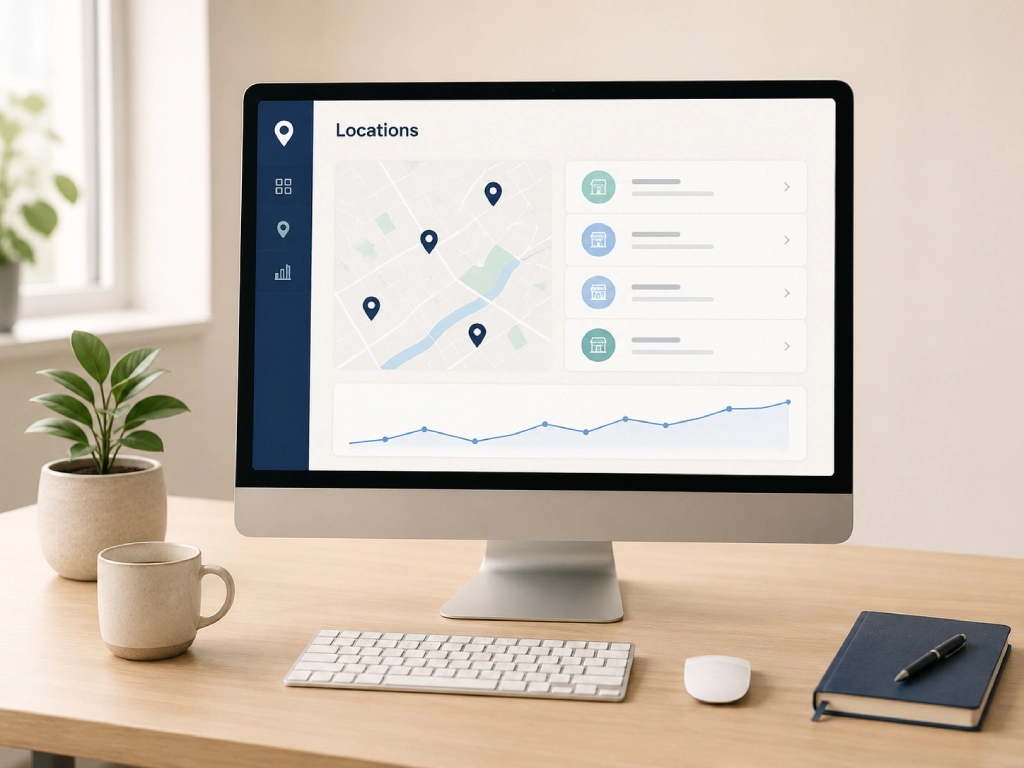
Twenty locations need process. At two hundred, you need machinery. Scaling multi-location SEO means building systems that hold quality steady as the location count climbs, so adding a market runs on a checklist your team can repeat.
Tracking & Reporting
You cannot scale what you cannot see. Per-location tracking turns a sprawling site into a dashboard you act on.
Track these at the location level:
- Local pack and organic rankings for each city’s primary keyword.
- Google Business Profile views, calls, and direction requests.
- Organic traffic and conversions per location page.
- Review count, average rating, and response rate.
Roll the location data up into one report so leadership sees the portfolio and your team sees the outliers. When the Colorado Springs page slips a few spots, you want to catch it in a weekly view, before the calls dry up. Tools like Google Search Console, Looker Studio, and a rank tracker with location filtering carry most of this load.
Centralized Systems & Automation
Manual work breaks at scale. Automation and central systems keep quality consistent when you pass a few dozen locations.
Where to centralize:
- Page templates: one structure, dynamic local fields, unique copy slotted in.
- Profile management: bulk updates through the Google Business Profile API or a platform.
- Citation management: one master record syncing to every directory.
- Review requests: automated triggers tied to your booking or POS system.
- Schema: programmatic LocalBusiness markup generated per page.
Automate the repetitive parts and reserve human attention for the work that differentiates a market: the local copy, the real photos, the genuine review responses. A flooring company opening its next showroom should launch a fully optimized page in a day, because the system already knows the pattern.
Advanced Multi-Location SEO Tactics
The fundamentals earn your rankings. The advanced layer keeps you ahead as search shifts toward AI answers and structured data. The tactics below matter most once your location pages and profiles are already solid.
Showing Up in AI Overviews and Local AI Answers
AI Overviews and assistants like ChatGPT now answer local questions directly, often before a user clicks anything. Google’s AI Overviews already appear on a meaningful share of local queries, and that share keeps climbing. AI search optimization now means becoming the source the AI cites.
To earn AI citations across locations:
- Answer questions plainly, in the format AI extracts: clear definitions, direct facts, tight lists.
- Keep Google Business Profiles complete, since AI answers lean heavily on profile data.
- Add FAQ content per location that matches how people actually ask.
- Earn mentions on third-party sites and directories the models trust.
Treat each location as its own entity that AI recognizes and recommends. A user asking an assistant for the best HVAC company in Denver should hit your structured, well-cited Denver presence first.
Dynamic Schema & Programmatic SEO
Schema markup is code that tells search engines exactly what your page contains. For multi-location sites, generating it dynamically per page is how you stay accurate at scale.
Use LocalBusiness schema on every location page, populated automatically from your location database:
- Name, address, and phone for that specific branch.
- Geo-coordinates and the areas served.
- Hours, including special hours.
- Aggregate rating pulled from real reviews.
Programmatic SEO takes the same idea further. Generate location pages in bulk from one template and a clean data set, each page unique, structured, and indexed. A statewide franchise builds a distinct, schema-rich page for every outlet from a single system. Quality control is the catch, so audit a sample regularly and keep thin pages out of the index.
Entity Optimization
Search engines understand the world through entities: people, places, businesses, and the relationships between them. Entity optimization makes Google see each location as a distinct, verified business connected to your brand.
Build entity strength per location with:
- Consistent NAP and structured data that match across the web.
- A presence on Google Business Profile, Maps, and trusted directories.
- Links and mentions that tie the location to its city and industry.
- Clear connections between the location and the parent brand.
The payoff shows up in both classic rankings and AI answers, since models reason over entities to decide who to recommend. When Google knows your Denver branch is a real HVAC company serving the city’s central neighborhoods, it ranks and recommends you with less hesitation.
Service-Area vs. Brick-and-Mortar Businesses
Not every multi-location business has a storefront, and Google treats the two models differently.
Brick-and-mortar businesses have a physical address customers visit, like a retail store or clinic. They show a full address on the profile and the location page, and proximity drives their rankings.
Service-area businesses travel to the customer, like plumbers, electricians, or mobile groomers. They hide the street address on Google Business Profile and define service areas by city or zip instead.
| Factor | Brick-and-mortar | Service-area |
| Address display | Full address shown | Address hidden, areas listed |
| Ranking driver | Proximity to searcher | Defined service zones |
| Page focus | The location itself | The areas served |
| Best for | Stores, clinics, restaurants | Plumbers, HVAC, mobile services |
A service-area brand still needs location pages, built around the cities it covers rather than a single pin on the map. A hybrid, like a Denver HVAC company with a shop plus a wide service radius, runs both plays at once. The model you fall into shapes how you structure pages, profiles, and proximity signals, so name it before you build.
Start Ranking Every Location
Strong local SEO for multiple locations comes down to repeatable systems. Map one keyword to one city, build pages a local would recognize, lock down your profiles and citations, then automate the parts that repeat. Layer schema, entity signals, and AI-ready answers on top once the basics hold.
Pick your top markets and start this week. Audit the profiles, fix the worst gaps, and track rankings location by location. Want a team to build and run the whole system? Unframed Digital does this every day.
Frequently Asked Questions
How do you rank a business in multiple cities?
Build one optimized page per city, each targeting a single local keyword, then back every location with a complete Google Business Profile, consistent citations, and steady local reviews.
Do multiple domains hurt multi-location SEO?
Usually. Separate domains split authority and multiply upkeep. Subfolders on one domain concentrate ranking power, so most multi-location brands see stronger results under a single site.
How do you optimize multiple locations on Google?
Claim and verify every Google Business Profile, then fill each with accurate NAP, correct categories, local photos, and regular posts. Use the API to manage them at scale.
How many locations can one website realistically rank?
There is no hard cap. Sites rank thousands of location pages when each stays unique, well-structured, and backed by a real local presence. Quality per page sets the ceiling.
How do you measure multi-location SEO success?
Track per-location rankings, profile actions, organic traffic, conversions, and reviews. Roll it into one portfolio report so you spot a slipping market before its calls drop.