
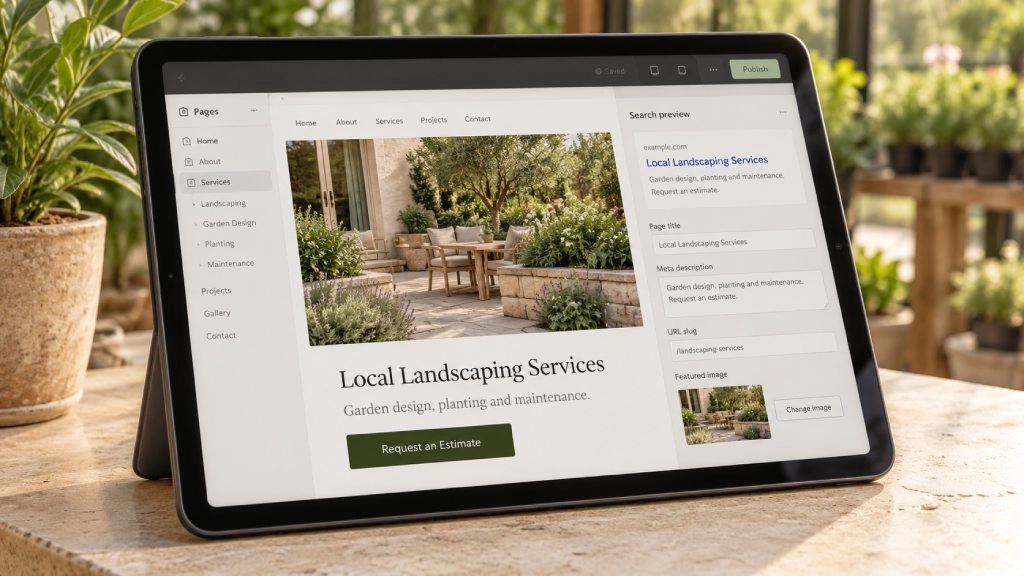
Effective landscaping marketing starts with identifying the right customers, building local visibility, choosing acquisition channels that fit, and converting inquiries into booked jobs. What works depends on the services you sell, the area you cover, your available budget, and how many jobs your crews can take on. Some owners run this in-house, and others bring in digital marketing services for landscapers once their priorities are clear.
1. Define your landscaping business’s target market
Marketing is more effective when it targets a clearly defined customer.
Identify your ideal landscaping customers
Your target market for landscaping is the group of customers whose property type, service needs, location, and budget best fit the work your crews do well. Find it by sorting recent jobs by property type, service, neighborhood, and whether the work repeats, then note who values reliability over the lowest bid.
| Customer type | Typical needs | Buying considerations | Suited channels | Sales approach |
| Residential maintenance | Weekly mowing, seasonal cleanups, bed care | Reliability, communication, price per visit, scheduling | Local search, referrals, neighborhood signage | Fast quote, simple recurring agreement |
| Residential design-build | Patios, planting plans, outdoor living, drainage | Portfolio, trust, design fit, timeline, project budget | Project photos, Business Profile, Meta ads, referrals | Consultation, site visit, detailed proposal |
| Commercial | Grounds upkeep for HOAs, offices, and retail | Capacity, insurance, consistency, references | Direct outreach, property managers, local search | Walkthrough, formal bid, written scope |
Choose your most profitable services and service areas
Profit comes from margin and efficiency, not invoice size. Depending on job costing, a large hardscape install that ties up a crew for weeks can earn less per labor hour than a tight route of maintenance accounts.
Pull costs, travel time, and crew hours for each service, then rank services and neighborhoods by margin, drive time, and the capacity you can honestly commit.
Define what makes your landscaping business different
Differentiation works when a customer can verify it. Specialization, relevant licenses, and verifiable certifications all carry weight.
Skip claims like “best in town” that nobody can check, and repeat one or two provable points across your website, profile, and estimates.
2. Build a strong local online presence
Customers search for services, locations, or “near me” options, then compare a handful of profiles and websites.
Optimize your Google Business Profile
A Google Business Profile puts your name, reviews, photos, and phone number in front of nearby searchers. Under Google’s Business Profile guidelines, use your real business name without adding keywords or taglines, and choose the fewest categories that describe your core work.
Businesses that do not serve customers at their address should hide it and list service areas instead, while hybrid businesses with a staffed storefront can show their address and also list service areas. Google’s general guidance is to keep those areas within about a two-hour drive of your base. No one can pay for or request a better local ranking, so a complete profile supports visibility without guaranteeing it.
Improve local SEO for your landscaping website
Local SEO helps your business capture demand from people searching for services in your area by aligning website content and your Business Profile with the services and locations that generate relevant searches.
Accurate service descriptions, fast mobile pages, and sensible internal links help search engines and visitors understand what you do and where. Repeating town names unnaturally or listing towns in blocks of text runs against Google’s spam policies on keyword stuffing.
Our local SEO services can help with profile optimization, local listings, and location-relevant website content. For SEO for lead generation, connect searches such as ‘patio installation near me’ with a relevant service page and a clear way to request an estimate
Create service and location pages that attract relevant customers
Service pages explain what you do, such as irrigation repair or retaining walls, and earn their place when a service has its own demand and details. Location pages suit areas where you have a real presence, such as a crew base or finished projects. Each needs an accurate description, local project examples, and practical details such as process and timelines.
Near-identical town pages that swap only the place name can amount to doorway abuse under Google’s spam policies. Cover areas that lack distinct information on a broader service-area page instead.
Make your website easy to navigate and request an estimate from
Put a tap-to-call number in the header and keep the menu to services, projects, areas served, and contact.
Place a “Request an Estimate” button in the header, on every service page, and after project galleries. Keep the form to a few fields, such as name, phone or email, town, and the work wanted.
Profile accuracy and policy checks:
- Business name matches your real-world name, without added keywords or taglines
- Address hidden if you do not serve customers there
- Service area limited to places you actually serve
- Fewest categories needed for your core work
- Hours and services kept accurate
- Reviews requested without incentives or filtering
Optional improvements:
- A page for each core service, with real project examples
- New project photos added regularly
- A reply to every review
- A short estimate form tested on a phone
3. Use content and social media to showcase your landscaping work
Customers need proof of workmanship before choosing a landscaper. Photos, helpful advice, and a few well-chosen social accounts supply it.
Publish before-and-after project photos and videos
Before-and-after photos show a transformation at a glance. Shoot from the same angle in similar light, label each set with the service, town, and season, and skip filters that overstate the result.
Get permission, ideally in writing, before publishing images where a customer’s address or property details are identifiable.
Share helpful landscaping tips and seasonal advice
Useful tips tie back to services you sell and conditions your customers face, such as when to overseed cool-season lawns, how to plan drainage before a patio goes in, or how to winterize irrigation.
Planning, writing, and publishing on a steady schedule takes time, so some owners bring in content marketing services to carry that workload.
Choose the right social media platforms for your customers
Choose platforms by where your customers spend time. Instagram and Pinterest fit visual project work, Facebook fits neighborhood groups and local referrals, and LinkedIn fits commercial relationships.
Prioritize the platforms you can manage consistently and evaluate their contribution to qualified inquiries.
Use local project examples to build credibility
A strong project example covers the customer’s problem, the work performed, the outcome, and the location. A title such as “Backyard drainage and patio rebuild in Naperville” gives readers and search engines the service and place at once.
Quote customers only with permission and describe only outcomes you can stand behind.
4. Generate landscaping leads with paid advertising
Paid advertising adds reach alongside local SEO and referrals. Search ads reach people actively looking for landscaping services, while social ads introduce your work to relevant audiences. The right mix depends on demand, goals, and your ability to handle new inquiries.
Run targeted Google search ads
Search ads reach people looking for specific services. Build separate campaigns for lawn maintenance or hardscaping, send each to a matching landing page, and target the towns you serve. Check advanced location options: presence targeting can help focus ads on people in or regularly in those areas, while the default can also include people interested in them. Use negative keywords to filter out irrelevant job-seeking and do-it-yourself searches.
Set a daily budget, which Google Ads treats as an average, so spend on a given day can run above or below it, and check monthly spending against your plan.
Track inquiry calls and form submissions separately from booked jobs. Record each inquiry’s outcome in your lead log or CRM, and use offline conversion imports or a supported integration to report later bookings to Google Ads. Choose the appropriate conversion goal for bidding rather than treating every funnel stage as the same outcome.
Owners short on time can have Google Ads management services handle bids, search terms, and budgets.
Evaluate Google Local Services Ads for eligible landscaping services
Local Services Ads place your business prominently in search results, and you pay for leads that match your services rather than for clicks. Google’s list of eligible categories includes landscaping services and lawn care services, but availability depends on your location, and eligibility and screening requirements apply. Check your category and area first.
Advertise on Facebook and Instagram
Meta platforms suit landscaping because the work is visual, and a finished project shows its value with little explanation. Use real project photos or short videos, a clear offer such as a design consultation, and location targeting around your service radius.
Visual campaigns suit design-led projects especially well, though suitability depends on the audience, offer, and goals. Choosing audiences, refreshing creative, and checking lead quality takes ongoing attention, which Meta Ads management can cover for owners without the time. Judge results by inquiries, not likes.
Set a realistic advertising budget and track lead quality
Start with a test budget that protects operating cash flow, weighing the margin on advertised services and how many new jobs your crews can absorb.
Run one or two campaigns for several weeks, calculate what a qualified inquiry cost and how many became booked jobs, and raise spending only on what produces wanted work.
5. Attract customers through reviews, referrals, and local marketing
Customers hand over their yards to people they have never met, so they lean on neighbors, reviews, and familiar names.
Build trust with customer reviews and testimonials
Ask for reviews right after the final walkthrough, with a direct link to your profile, and ask every customer the same way. Reply professionally to every review, including critical ones, and feature testimonials only with permission.
Never offer discounts, gifts, or payment for reviews, never filter who you ask, and never write reviews yourself. Google’s policy on fake engagement and incentivized reviews prohibits offering incentives for Google reviews, whatever their sentiment, and the FTC’s rule on fake reviews and testimonials separately bars fake reviews and incentives conditioned on a particular sentiment.
Encourage referrals from satisfied customers
Ask for referrals when a customer compliments the finished job, and hand them a short message or contact card to pass along.
Referral rewards follow different rules from review incentives. A service credit for introducing a new customer works best with written terms covering who qualifies, what the reward is, and when it is paid. If a referrer promotes you publicly in exchange for a reward, disclose that connection where applicable, and never tie a reward to a review.
Use yard signs, vehicle branding, and neighborhood marketing
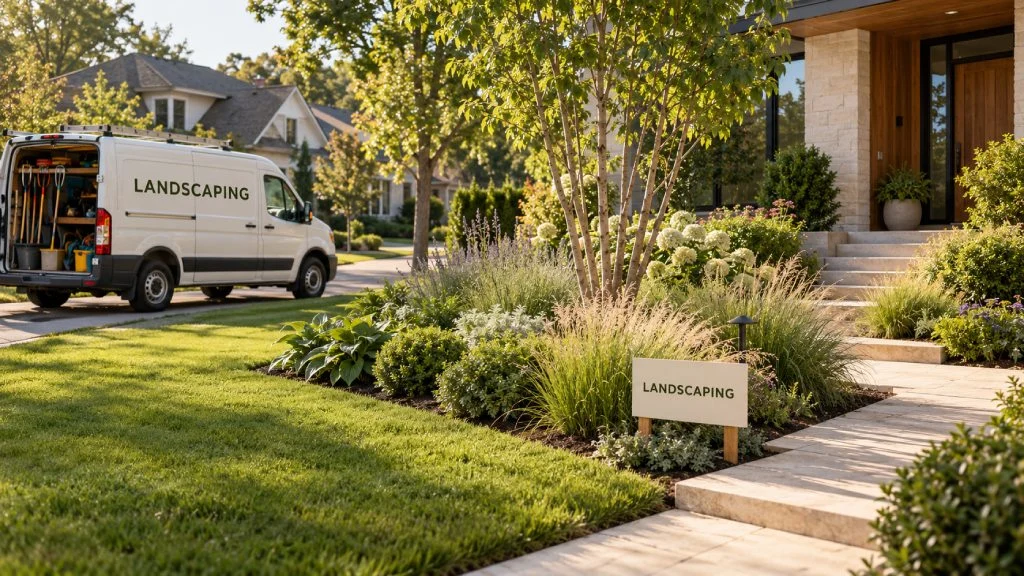
Yard signs and vehicle branding are practical landscaping advertising ideas that build awareness near active and completed projects. Get the homeowner’s consent first, check municipal and HOA rules on sign size, number, and placement, and keep branding clear and readable.
Develop partnerships with local businesses and property professionals
Partnerships work when both sides serve the same customer at different moments, such as real estate agents wanting curb appeal before a listing, property managers wanting dependable crews, and nurseries meeting homeowners who need installation.
Approach with something specific, such as a before-and-after set, and treat each as a relationship, not a guaranteed lead source.
Stay in touch with existing customers through seasonal follow-ups
Send existing customers reminders when ahead of seasonal work, such as spring cleanup, fall aeration, or irrigation shutdown.
Before sending seasonal email or SMS campaigns, check the consent and opt-out requirements that apply to your business. US commercial marketing emails generally need a valid postal address and an unsubscribe option. Automated promotional texts may require prior express written consent under applicable federal and state rules. Keep records of customer permissions and honor opt-out requests.
6. Turn landscaping leads into booked jobs
Marketing creates inquiries, and the sales process decides how many become jobs.
Make it easy for prospects to request estimates
Make the “Request an Estimate” path easy to find wherever a prospect lands. Beyond contact details, ask for the service wanted, property address, and preferred timing, with a rough scope and photos optional.
Then say what happens next, such as a call within one business day followed by a site visit or written estimate, and match the promise to your real schedule.
Respond quickly and qualify new inquiries
Prompt replies show the reliability customers are trying to judge, so respond the same day when possible. Then qualify with these five questions:
- Is the address in your service area?
- What work do they want?
- Is the budget realistic for the scope?
- When do they need it done?
- Does it fit your crew and calendar?
Politely refer out jobs you cannot serve well.
Follow up on estimates without being pushy
A follow-up can answer questions, confirm scope, and offer a next step, such as adjusting the plan or holding a start date. If the answer is no, ask whether you can check in next season. Timing depends on job size and the customer’s preferred way to communicate.
- Capture the inquiry: source, contact details, and requested service
- Qualify: confirm location, scope, timing, and fit
- Schedule the site visit or estimate call
- Deliver the proposal with scope, price, and timeline
- Follow up politely with a helpful next step (for example, a few days for a small job and a week for a larger one)
- Record the outcome as won, lost, or on hold, and why
Track which leads become paying customers
A spreadsheet works to start, and a CRM helps once volume grows. Record each lead’s date, source, requested service, qualification status, estimate amount and date, outcome, booked-job value, and the reason any job was lost. Update it weekly so a season’s data shows which sources produced booked work.
7. Create a landscaping marketing plan

A landscaping marketing plan connects your growth goals with the customers you want to reach, the channels most likely to reach them, and the resources needed to execute.
Set clear marketing goals based on your business capacity
Set goals the business can deliver. Qualified leads, estimates, recurring contracts, and booked projects each make a workable target.
Work backward from capacity, since a goal beyond what your crews can take on only creates a backlog. Pair every goal with a time frame and a measure, such as “six booked design-build consultations by April.”
Choose marketing strategies for your goals and budget
Each channel earns its place in different circumstances.
| Channel | Suited goal | Cost considerations | Effort | Time horizon | Fits best when |
| Local SEO | Steady inbound inquiries | Content, technical upkeep, optional outside support | Moderate, ongoing | Inquiries may build over months | You serve defined towns |
| Referrals | Trusted, well-fitting jobs | Mostly time; any rewards cost extra | Low to moderate | Inquiries can follow finished jobs and grow over time | You have happy customers and capacity |
| Google Ads | Service-specific inquiries | Ad spend plus management | Moderate to high | Visibility can begin after launch; lead volume varies | You need work soon and can track results |
| Organic social media | Showcasing projects | Mostly time and content production | Moderate, ongoing | Awareness may build gradually | Your work photographs well |
| Offline marketing | Neighborhood awareness | Printing and placement | Low to moderate | Awareness varies with neighborhood density | Jobs cluster in tight areas |
Pick the channel that matches your most pressing goal, then add a second once the first runs reliably.
Build a seasonal landscaping marketing calendar
Build the calendar around when customers decide, not when the work happens, and match each push to local weather and crew hours.
- Winter (colder regions): pre-book next season, schedule design-build consultations, and produce content
- Late winter to early spring: promote maintenance sign-ups before the local mowing season begins
- Summer: showcase finished projects and ask for reviews
- Fall: promote cleanup, aeration, and planting
Assign responsibilities and set an implementation schedule
Every task needs one name next to it.
- Daily: respond to new inquiries, ideally the same day
- Weekly: check the lead log, reply to reviews, and review ad spend and search terms
- Monthly: plan content, adjust ads, and compare results
- Quarterly: review the whole plan
Owners who want more planning detail can use the steps to create a marketing plan for a fuller framework.
A hypothetical two-crew company offering lawn maintenance and small patio installs shows how the pieces fit. It targets homeowners in three nearby towns and has capacity for eight new weekly maintenance accounts and two patio projects by June. If roughly two in three qualified maintenance inquiries book, and two in five patio consultations, the targets become twelve qualified maintenance inquiries and five patio consultations by the end of May. Different conversion rates would change those targets.
The plan rests on three channels, which are local SEO and the Business Profile for steady search demand, referrals for trusted maintenance accounts, and search ads from March through May for patio inquiries. The owner sets a fixed monthly advertising budget based on cash flow and pauses ads once the crews are full. The office manager owns replies and the lead log, and a monthly review checks cost per qualified inquiry, close rate, and booked jobs against target.
8. Measure and improve your landscaping marketing results
Clicks and impressions show campaign activity, but they do not establish lead quality or commercial value.
Track leads, estimates, booked jobs, and acquisition costs
Define each term once and use it the same way every month, so results stay comparable.
| Metric | Definition or formula | How to read it |
| Lead | One distinct prospective customer inquiry; repeat calls or messages about the same job count once | Volume only, not fit |
| Qualified inquiry | Lead in your area, for a service you offer, within your timeline | Fit |
| Estimate | Priced proposal delivered to a qualified inquiry | Sales activity |
| Booked job | Customer-accepted estimate or agreement, counted once | Real outcome |
| New customer | First-time customer, counted once even if they book several jobs | Customer growth |
| Qualification rate | (Qualified inquiries ÷ leads) × 100 | Lead quality |
| Close rate | (Booked jobs ÷ estimates delivered) × 100 | Sales effectiveness |
| Cost per lead | Marketing spend ÷ leads | Cost of an inquiry |
| Ad cost per booked job | Ad spend ÷ booked jobs from those ads | Efficiency of one channel |
| Customer acquisition cost | All marketing and sales cost ÷ new customers | Full cost of winning a customer |
- Report each cost for a stated period, such as a month, and say whether it is channel-specific, like ad cost per booked job, or business-wide, like customer acquisition cost.
- To measure conversion, follow the same group of leads through estimates and bookings, since a lead can convert in a later period.
- Compare acquisition cost with gross profit, not revenue, and remember that a first installation can understate the value of a recurring maintenance customer.
Compare marketing channels by lead quality and business value
Two channels can cost the same per lead while one brings price-shoppers outside your area and the other brings maintenance accounts that renew for years. Compare channels by qualification rate, close rate, average job value, and fit with your services.
Dedicated tracking numbers and a “How did you hear about us?” question help attribute phone inquiries to their source.
Adjust your marketing plan based on results and seasonality
Review results monthly and compare like with like, such as this April against last April, since seasonal swings can make a healthy campaign look weak. Give more room to channels that produce booked work, and tighten targeting or pause those that fill the calendar with poor-fit jobs.
Check crew capacity before any increase, and change one thing at a time so you can see what worked.
Ready to put your landscaping marketing plan into action?
Start with the marketing opportunities that best fit your services, customers, and capacity. A focused strategy can help you prioritize investment and connect local search, content, paid media, and lead generation more effectively.
At Unframed Digital, we develop custom search and digital marketing strategies around each business’s goals, market, and existing resources. The next step is to talk with our team about your landscaping business and where a coordinated marketing strategy could help.
Frequently asked questions about landscaping business marketing
What is the best way to advertise a landscaping business?
Local search, referrals, and paid ads each win in different situations. Local SEO suits service-area companies, referrals suit trust-heavy projects, and Google or Meta ads can create visibility faster, though inquiries depend on targeting, budget, and campaign quality.
How can I market my landscaping business with a small budget?
Start with the resources you already have. Complete your Business Profile, request genuine reviews and referrals, publish recent project photos, and respond promptly to every inquiry. Add paid channels once those basics are working.
Who is the target market for a landscaping business?
Residential customers include homeowners wanting maintenance or design-build work, and commercial customers include HOAs, property managers, and businesses needing grounds care. The best audience depends on the services you offer and the area you serve.
How much should a landscaping business spend on marketing?
No single percentage fits every company. Spending depends on your margins, goals, crew capacity, and what a qualified inquiry costs you. Set a test budget you can afford, track booked jobs, and adjust as the numbers come in.
How can I get more landscaping customers during the slow season?
Send past customers seasonal reminders and pre-season booking offers, and promote weather-suited services such as pruning or design consultations. Partnerships with builders, property managers, and nurseries can fill gaps. Advance booking for spring helps the calendar start full.
How long does landscaping marketing take to produce results?
Paid campaigns can generate visibility after launch, but inquiries depend on targeting, budget, and campaign quality. Referrals depend on customer relationships and opportunities to recommend your work. Local SEO and content typically build over months. The time needed to turn an inquiry into a booked job also depends on the service and sales cycle.