

A B2B content marketing funnel is a planning framework that matches each asset to what a buyer already understands and how close that buyer is to committing budget. One opportunity can involve a specifier, technical lead, finance approver, and procurement manager, each researching different questions before anyone contacts sales. An SEO content strategy organized around those questions connects related assets and exposes gaps that a topic-led publishing calendar can miss.
The framework is a planning device, not a description of how people actually buy. Use it to organize audiences, questions, assets, and next steps, and you get a structure you can build, connect, and measure.
The Three Core B2B Content Funnel Stages
Funnel models vary. This guide uses three core pre-purchase stages: awareness, consideration, and decision. It treats onboarding, retention and advocacy as post-purchase support.
A case study can serve awareness when it reaches someone who has not yet named the problem, and a short article can close a deal when it answers the last objection standing between a committee and a signature. Planning content for every stage of the buyer journey means sorting assets by the job they perform, because teams that sort by format end up with heavy duplication at the top of the funnel and very little support at the bottom, where revenue is actually decided.
| Stage | What the Prospect Is Doing | Questions Being Asked | Suitable Content | CTA Type |
| Awareness | Identifying or defining a problem | What is happening? Why does it matter? What are the risks? | Educational articles, research, introductory guides, video | Related resource or newsletter signup |
| Consideration | Evaluating possible approaches | What options exist? How do they work? Which requirements matter? | Detailed guides, webinars, checklists, technical resources, comparisons | Download, webinar registration, relevant case study |
| Decision | Assessing providers and purchase risk | Can this provider deliver? What evidence exists? What does implementation involve? | Service pages, case studies, testimonials, demos, ROI tools | Consultation, proposal, sample or demo |
Top-of-Funnel Content for Awareness
Awareness content reaches people before they have any reason to look for a supplier. Someone researching why a material fails in freeze-thaw conditions is not shopping yet, but they are forming a view of who understands the problem. Educational articles, original research, and introductory explainers put your brand into that early stage of the conversation, where competitors with narrower content never appear.
Breadth has limits. Broad subjects work when they connect to expertise your company genuinely holds, and they stop working the moment they drift into territory your team cannot speak about with authority. Keep the sales conversation out of it as well. Awareness readers pushed toward a consultation before they have defined their own problem tend to leave and remember the experience.
Middle-of-Funnel Content for Consideration
Consideration content helps buyers compare approaches and work out what their own requirements should be. By this point, the question has shifted from what is happening to which method fits, so detailed guides, technical resources, comparison content, and webinars carry more weight than another introductory explainer.
Objections surface here too, and they are usually the ones that never make it into a brief: compatibility with existing systems, installation complexity, warranty exposure, internal resistance to changing a specification. Content that answers those directly earns the next click. From there, readers should have somewhere to go, whether that is a specification resource, a technical document, or evidence of the approach working elsewhere.
Bottom-of-Funnel Content for Decision-Making
Decision content answers a narrower question: can this particular provider be trusted with this particular project? Service pages, case studies, testimonials, demonstrations, and ROI tools all address provider suitability, implementation reality, and the risk of choosing wrong. At this point, committees are looking for reasons to eliminate options, so vagueness costs you more than it does anywhere else in the funnel. Case studies do most of the work when they resemble the reader’s situation in scale, sector, and constraints, and commercial pages carry the rest provided they explain how the engagement actually runs. Next steps should match the intent: a proposal, a sample, a technical consultation or a demo, rather than another download.
The relationship does not end at the signature. Onboarding documentation, implementation support, product updates, and customer stories keep the account healthy after the sale, and satisfied customers generate the references that later feed decision-stage content for someone else. Most B2B teams under-resource this part of the funnel, then wonder why renewal conversations start from a cold position.
Why B2B Buying Journeys Are Not Linear
Stakeholders enter the process at different points. A technical lead may have been researching the problem for months before a procurement manager joins and starts from zero, needing awareness content while colleagues are already comparing vendors. New objections then send the group backwards: a financial constraint reopens the shortlist, or an operational review raises a compatibility issue nobody flagged, and the team returns to comparing approaches. Several stages also run at once, since different people forward each other different things. Gartner research on the B2B buying journey puts the share of buyers who would prefer a purchase experience with no sales rep involved at around three-quarters, which puts the weight on content that answers without a conversation, and on making the conversation easy to start for the stakeholder who does want one.
Content paths need to allow for that. Someone should be able to enter at a decision-stage page, move backwards into a technical guide, leave for three weeks, and return without hitting a sequence that assumes they read step one. Internal links, related resources, and clear next steps do that work quietly, where prescribed nurture tracks rarely do. Build the funnel as a structure rather than a route, because buying behavior will not follow the route anyway.
How to Build a B2B Content Marketing Funnel
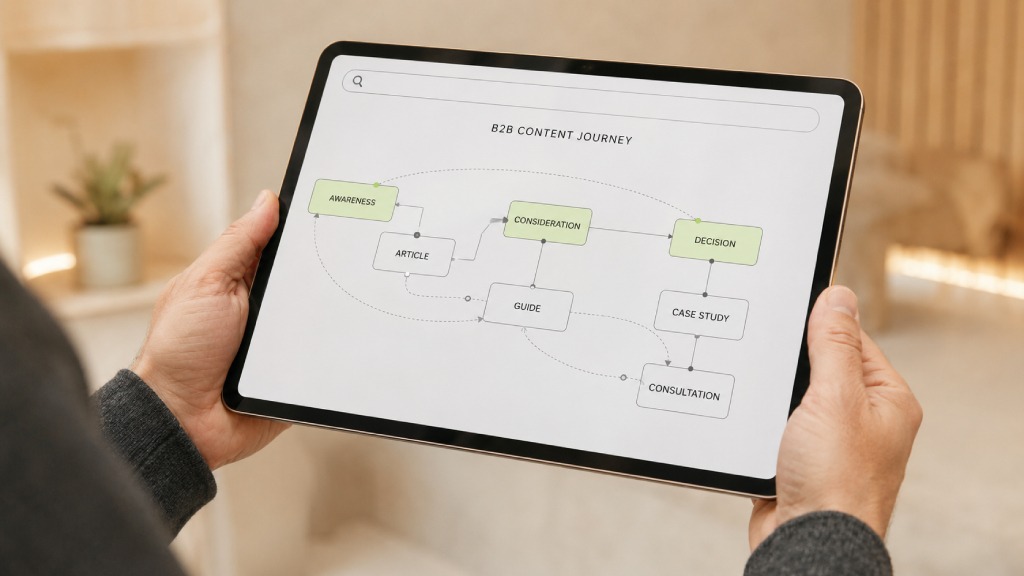
A completed funnel documents who you are targeting, what they ask at each stage, which assets answer those questions, where coverage is missing, what each asset asks the reader to do next, and how you will judge whether any of it worked. Anything less becomes a content calendar with stage labels attached.
A hypothetical building materials manufacturer makes the process easier to follow. The company sells exterior cladding systems, reaches the market through specifiers and distributors, and competes on technical performance rather than price.
Define the Ideal Customer Profile and Buying Committee
Start with the organizations worth winning and the people inside them who influence the outcome. Company size, project type, procurement model and technical sophistication matter more than industry labels, because two firms in the same sector can buy in completely different ways.
For the cladding manufacturer, architects and specifiers need performance data, detailing guidance and confidence that the product will survive design review. Contractors care about installation sequence, tolerances, lead times and what happens when something arrives damaged. Procurement teams weigh supply reliability, pricing structure and warranty terms. Three audiences, one purchase, almost no overlap in what they need to read.
Map Questions, Objections and Search Intent
Questions come from four places worth mining regularly: keyword research, customer interviews, support tickets, and recorded sales calls. Search data shows you the language people use in public, and reading the search intent behind each query tells you which stage that language belongs to, since a definitional question and a comparison question need entirely different pages. The other three sources show you what buyers say when they are being honest about risk.
Mapped for the manufacturer, the progression runs from general material selection queries, through comparisons of substrate systems and fixing methods, into fire performance requirements, thermal movement tolerances and warranty scope, and finally into supplier evaluation. Each of those bands sits at a different stage, and each one contains objections the sales team hears weekly.
Audit Existing Content and Identify Gaps
Every existing asset gets four attributes: audience, stage, primary purpose, and intended next action. Assets that resist classification are usually the problem, because content written without a defined reader tends to serve none of them.
The patterns worth checking for are duplicated coverage, outdated material and thin stages. Duplicated coverage puts several articles on one awareness question, where they compete with each other. Outdated material sits on standards, specifications, or product ranges that have moved on. Thin stages tend to be the costly ones, and for the cladding manufacturer that might show up as plenty of educational articles, a product catalog, and nothing in between that helps a committee justify the choice internally, while installation and specification questions are handled well in sales conversations but barely covered on the site. A content gap analysis surfaces that kind of imbalance faster than an internal review does, because it measures your coverage against questions the market is already answering elsewhere.
Prioritize and Connect Content by Funnel Stage
Sequencing is a balance between audience relevance, search opportunity and proximity to revenue. High-volume awareness topics look attractive on a spreadsheet and rarely deserve the first slot when the decision stage is empty.
Connection matters as much as production. An awareness guide on cladding failure modes should lead into a specification checklist, then into a project case study, then into a sample request. The internal links between related resources are what make that path exist at all, and without them each asset becomes a dead end that sends the reader back to a search box where a competitor is waiting.
Coordinate Distribution, Nurturing and Sales Support
Publishing is the start of the work. Organic search brings people in over time, email keeps a slow-moving opportunity warm, social and industry channels reach specifiers who are not searching yet, and remarketing keeps decision-stage evidence in front of a committee during the weeks when nothing appears to be happening. Sales enablement closes the loop, because the same case study that ranks for a technical query also belongs in a follow-up email after a site visit.
The sales team is running this research already, one conversation at a time. Ask which questions keep coming up on calls, which objections stall deals, and which competitor claims need answering, then feed those straight back into the map. One asset can support several channels at once without repeating itself: the manufacturer’s specification checklist works as a search-visible resource, an email nurture asset, a lead capture point, and a leave-behind after a specifier meeting, with different framing in each context.
B2B Content Funnel Checklist
Before signing off on a funnel, run it against a short set of structural questions. Anything that fails one of these is a gap worth closing before the next production cycle.
- Does every asset address a defined audience and a specific question?
- Are all three stages adequately represented, not just the top?
- Does each asset have one primary purpose rather than three competing ones?
- Is there a relevant next step from every page?
- Do internal links connect related resources across stages?
- Are all important stakeholders in the buying committee represented?
- Can meaningful outcomes be tracked, not only pageviews?
- Is there a process for reviewing and updating the funnel?
How AI Search Changes the B2B Content Funnel
AI answers can affect funnel stages differently, but the pattern depends on the query. Definitional questions are often easier to answer from widely available information, so a buyer asking what a ventilated facade is or why thermal bridging causes problems may continue researching without visiting a website. The same can apply to broad consideration questions based on standard comparison criteria.
Decision-stage questions often require more business-specific evidence. A buyer assessing a supplier’s tolerances, implementation process, warranty terms, or results on a comparable project needs information that only that business can publish and verify. This does not make decision content immune to AI summaries. It makes original evidence and specific detail more valuable. Google’s guidance on AI features and your website confirms that AI Overviews and AI Mode require no special optimization beyond established SEO practices, so AI search optimization should focus on making useful, verifiable information easy to find and cite.
The shift is one of weighting rather than abandonment. Awareness content still builds recognition and feeds citations, but funnel investment concentrated on easily summarized introductory material is the exposure worth reducing, and original research, project evidence, and specific decision support happen to be what a buying committee needs to see anyway.
B2B Funnel Metrics to Track at Each Stage
Measurement fails when every asset is judged by conversions. An awareness article that produces no inquiries is doing its job if it reaches the right audience and moves people onward, while a decision-stage page that attracts traffic and generates nothing has a real problem. Stage-specific indicators tell you whether each layer is functioning. Pipeline outcomes tell you whether the funnel as a whole is contributing.
| Funnel Stage | Primary Objective | Relevant Metrics | Possible Warning Signs |
| Awareness | Reach relevant audiences | Search and AI visibility, qualified traffic, engagement, subscriptions | Traffic arrives from irrelevant queries or goes no further |
| Consideration | Generate deeper interest | Returning visitors, downloads, registrations, email engagement, qualified leads | Prospects consume one asset and never reach a second |
| Decision | Influence opportunities and revenue | Consultations, demos, sales-qualified leads, assisted conversions, influenced pipeline | High-intent pages draw traffic but produce few qualified inquiries |
Three measures connect the whole structure. Stage-to-stage conversion rates can reveal where progression stalls. Sales-cycle length may indicate whether prospects are arriving better informed, although many other factors affect it. Content-assisted revenue can show which tracked assets appeared in closed deals without assigning all credit to the last click. Branded search volume, assisted visits, and multi-touch attribution fill in more of the picture without closing the gap entirely, because much B2B research is anonymous and a growing share of it now resolves without a visit at all. Setting the SEO KPIs worth reporting before an asset goes live matters for the same reason, since the numbers that prove an awareness article worked are not the ones that judge a service page.
Traffic alone proves nothing about pipeline contribution. A page can rank, attract thousands of sessions and never appear in a single closed opportunity, while a specification resource with modest visits appears in deal after deal. Use weak metrics diagnostically: a stage with poor progression points to a missing asset or a broken path, which is more useful than a verdict on any individual page.
Plan B2B Content Around Real Buying Decisions
A funnel is only as good as the questions it answers. Genuine objections, real evaluation criteria, and the specific evidence a committee needs to justify its choice are what separate a working structure from a stage-labeled calendar, and they come from customers and sales conversations rather than from a template.
The combination is what performs: assets built for a defined stage, paths that connect them in whatever order a buyer chooses, and measurement that credits contribution instead of clicks.
Unframed Digital helps B2B teams turn scattered content and visible gaps into a structured SEO content strategy that supports the whole decision, from the first search to final approval. If your content library is difficult to connect to real buying questions or pipeline, talk to the Unframed Digital team about building a practical content roadmap.
Frequently Asked Questions
What Is the Difference Between a B2B Content Marketing Funnel and a Sales Funnel?
A content funnel organizes the information buyers need at each stage of their research. A sales funnel tracks commercial progress through qualification, opportunity, and close, and is managed by the sales team in the CRM.
How Long Does a B2B Content Funnel Take to Produce Results?
Timing depends on your sales cycle length, existing authority, how many stage gaps you are filling, and how actively you distribute. Longer cycles delay revenue signals even when engagement improves within the first months.
Should B2B Content Be Gated at Every Funnel Stage?
No. Gating awareness content suppresses reach and search visibility for little return. Reserve forms for consideration and decision assets, where the exchange is worth the friction and the information collected genuinely qualifies interest.
Who Owns the B2B Content Funnel, Marketing or Sales?
Marketing usually owns the framework, production, and measurement. Sales contributes the questions, objections, and deal feedback that keep it accurate. Without that feedback loop, the funnel drifts toward content nobody in the room recognizes.