

Marketing a SaaS product means giving the right buyers a clear reason to choose your software and keep using it. If campaigns generate interest but few suitable customers, review the audience, positioning, website, and product evaluation process together.
Those decisions also inform our SaaS SEO services, where search strategy connects buyer questions with relevant pages and conversion paths. This guide explains how to make those decisions for a new product or refine them for an established SaaS business.
Define the customers and problem your product serves
Define the customer group using evidence from sales conversations, product usage, and retention. Identify the workflow the product supports, who uses it, who approves the purchase, and what makes replacing the current approach worthwhile. For an established product, compare customers who adopt and renew with those who stall or leave; the segment generating the most signups may not be the strongest fit.
A scheduling and dispatch tool for HVAC and plumbing companies is the hypothetical example that illustrates each step that follows, not an Unframed client. We’ll look at who uses the software, who approves the purchase, and the scheduling problems each person needs it to solve.
Identify users, buyers, and buying triggers
For the hypothetical scheduling tool, the customer profile could look like this:
- User: An office manager or dispatcher managing the schedule through a whiteboard, spreadsheet, or group text. They want fewer calls to confirm which technician is available.
- Buyer: The owner, who weighs technician idle time, job assignment speed, and subscription cost against potential savings.
- Buying trigger: The company adds technicians and its existing scheduling process becomes harder to manage.
The user and buyer may need different messages because they evaluate the tool for different reasons. Check these assumptions against customer conversations, sales notes, and product data before treating them as established.
Research customer language and alternatives
Interviews, sales call notes, support tickets, reviews of similar tools, and the alternative a prospect is currently using all describe the same problem in the customer’s own words rather than the vendor’s. That alternative is often not a competing product at all. For this hypothetical company, assume some prospects are getting by on a shared spreadsheet, a paper board in the shop, or a coordinator who manages everything by phone, any of which counts as the real competition for that prospect’s attention.
One research finding can change a message on its own. If interviews turn up dispatchers describing the problem as not knowing which technician is actually free when a new job comes in rather than scheduling software, a feature-led headline about real-time calendars says less to that reader than a problem-led one about that exact gap. The words customers already use are usually a better opening line than the vendor’s own internal name for the feature.
Position the product around a clear outcome
A value proposition names four things, from the audience and the problem they have to the capability that addresses it and the benefit that follows.
In our hypothetical scheduling tool example, the customers are HVAC and plumbing companies with five or more technicians. Their dispatchers struggle to see who is available when a new job comes in. A shared dispatch board that updates when technicians mark jobs complete could help the office assign work with fewer calls to check availability.
That specific capability gives buyers something concrete to evaluate. Labels like “all-in-one” or “revolutionary” do little to explain why they should choose one tool over another.
Test the message before expanding promotion
A new or repositioned message is worth testing on a small scale before it goes into paid campaigns or a content calendar built around it. For example, speak with ten prospects who match the customer profile and offer a two-week trial with setup help. Record their concerns, such as the cost per technician or whether the crew will use another app. The pattern in those objections, not a guess at what might come up, is what shapes the next draft of the message.
An established product can run the same test against sales calls and support conversations it already has instead of new outreach.
Make the website useful to prospective buyers
A prospect who lands on the site needs to answer one question fast: does this apply to me? A short checklist covers what that takes to show clearly:
- Use case: does a page speak to this visitor’s specific business, not the category in general
- Features: is it clear what the product does, rather than a list of benefit words
- Integrations: are the tools this buyer already uses supported, where that’s relevant
- Pricing: can a visitor tell roughly what this costs, or at least how pricing works
- Proof: is there a case study, review, or number beyond a vendor’s own claim
- Next step: is it obvious whether to start a trial, book a demo, or ask a question
For the scheduling tool, separate pages for HVAC and plumbing companies would make sense if their terminology, busy seasons, or buying questions differ enough to need distinct answers. Otherwise, one strong use-case page can serve both. A use-case page like that also tends to be what a prospect searches for directly, and a comparison page against a spreadsheet or a specific competitor captures a different, more decided kind of search, which is where search-led content and page strategy come in.
Choose and sequence SaaS marketing channels
Which channel to test first depends on where the audience already looks for solutions, how many people are involved in the buying decision, what stage the product is at, and how much budget and time the team actually has to run a test. Start with a focused set of channels, each with a specific goal and enough team capacity to evaluate it.
Before each test, agree on the target customer group, primary goal, owner, budget, and review point. Allow enough time to observe the relevant buying cycle, then decide whether to continue, adjust, or stop based on lead quality and progress toward that goal.
| Channel | Suits this situation | Initial test | Result to watch |
| SEO and content | The audience searches for the problem or compares named tools before buying | Publish one problem-focused page and one comparison page | Whether either page earns relevant search visits and trial signups over a few months |
| Paid search | The audience already searches with buying intent, and a fast read is needed | A small campaign on a handful of bottom-funnel terms | Whether clicks turn into qualified trials or demos, rather than traffic alone |
| Partnerships and integrations | The audience already uses a specific tool or works with a specific vendor | One integration or referral arrangement with a complementary tool | Whether the partner sends qualified leads, not a listing on its own |
| Community participation | The audience gathers in an identifiable forum, group, or association | Answering real questions in that space for a set period | Whether it produces genuine conversations, not visibility alone |
| Direct outreach | The ideal customer is identifiable by name and reachable individually | A short list contacted with one relevant, specific reason to talk | Whether it produces real replies and meetings, not sends alone |
No channel here is universally the right move; the table is a starting point for matching one to what’s actually known about the audience.
Compare what each channel reveals about the same customer group. Objections raised in outreach can expose questions missing from comparison pages, while paid-search results can help test messages for selected searches. Review those findings alongside sales and product data before expanding investment.
SEO and content marketing
Content earns its place through two kinds of pages, ones that address the problem a prospect has before they know a product like this exists, and ones that help them evaluate a specific tool once they’re comparing options.
The first kind matches an informational search, like a dispatcher searching for ways to tell which technician is actually free before assigning a job. The second matches a decision-stage search, like someone comparing the scheduling tool against a named competitor or against sticking with a spreadsheet. A SaaS SEO strategy connects both kinds of pages to the questions suitable buyers actually ask.
Either kind of page needs a next step that fits where the reader actually is. A problem-stage page can point toward a related read or a low-commitment signup, while a comparison page can point straight at a trial or demo, since that reader is closer to deciding. Outside support can help the team prioritize buyer questions, plan the pages that address them, and maintain that work through our content marketing services.
Paid search and other paid campaigns
A limited paid search campaign can show how a specific message and landing page perform against selected searches, and reach people who are already searching with a specific problem or product in mind. Match the landing page to the search. Someone comparing tools needs a page that explains the relevant differences. Then assess whether the campaign produces qualified trials or demo requests, alongside its click count.
A team that needs help setting up and managing that kind of campaign, from keyword and audience targeting through to the landing pages behind each ad, can use our Google Ads management service. What a specific campaign will cost or convert at depends on the audience, the market, and the offer. Use forecasts to set an initial budget, state their assumptions, and revise them against the quality and cost of the trials or demos the campaign produces.
Communities, partnerships, and direct outreach
How to promote a SaaS product beyond the website and paid campaigns comes down to three approaches, from joining conversations already happening to partnering with adjacent businesses and reaching a small list of prospects directly.
- Communities: Answer relevant questions in spaces such as trade association forums or HVAC contractors’ groups.
- Partnerships: Work with complementary businesses that already reach the same audience, such as payroll or invoicing providers.
- Direct outreach: Contact a defined group of prospects with a specific reason to talk. A recent field-team expansion could be a useful starting point, but does not confirm that they need the tool.
Turn interest into trials, demos, and customers
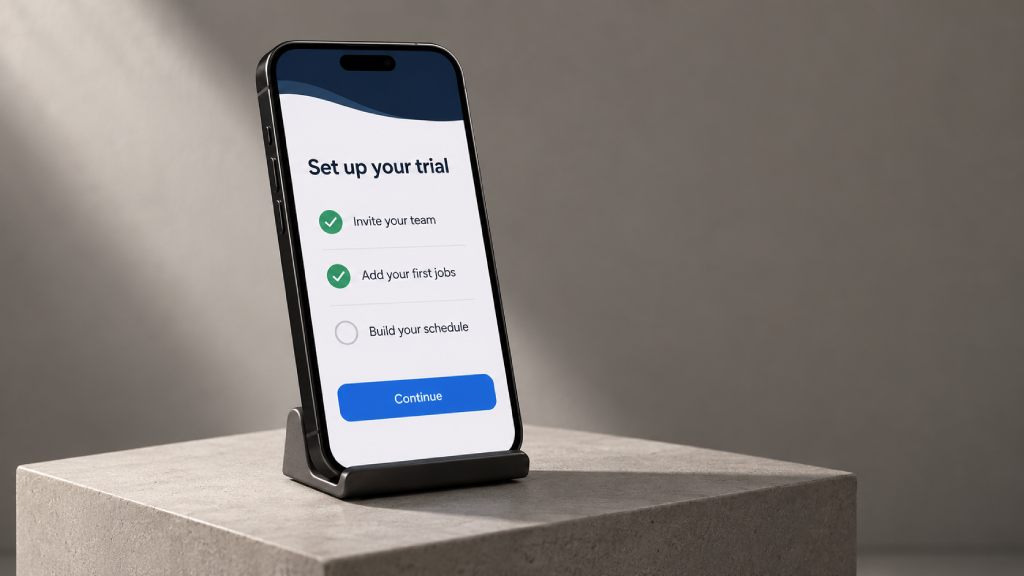
Turning interest into a customer depends on a clear next step and a useful first experience. Prospects need enough information to feel confident trying the software, then guidance that helps them see its value.
For the scheduling tool, that sequence starts the moment someone clicks start a trial and doesn’t end until their crew’s first full day is running on the new schedule.
Choose a suitable trial or demo path
A self-serve trial or free tier works when a prospect can evaluate the product’s value on their own, without much setup or a second decision maker in the room. A demo or a sales conversation works better when the purchase is complex enough to need explanation, or when more than one person, like the scheduling tool’s dispatcher and its owner, needs to be convinced for different reasons.
Pricing clarity matters to either path, since a clear sense of cost, or an easy way to get one, helps a prospect judge whether the product fits their budget before they commit to a trial or a demo.
If the owner of a five-technician plumbing company can set up the tool and test it with a few jobs independently, a self-serve trial may fit. For a larger company where the owner is only involved once the office manager has vetted a shortlist, a short demo gives the office manager something concrete to bring back to that conversation. Neither path is the right choice for every SaaS product; which one fits depends on how that specific buyer already decides.
Reduce friction before and after sign-up
The obstacles worth fixing are the ones an actual prospect runs into, not a general sense that the experience could feel smoother.
- A sign-up form asking for a company’s full technician roster before showing any value is friction.
- A demo booking calendar with no slots for two weeks is friction.
- A trial that starts with a blank dashboard and no clear first action, like loading tomorrow’s jobs, is friction too, even though nothing about it looks broken.
A case study from a similarly sized company can answer questions a feature list leaves open when it shows a specific, verifiable result.
Follow up based on buyer behavior
Useful follow-up responds to something specific the prospect did or asked, not a generic nudge sent to everyone on the same schedule. If a trial account never adds any technicians in the first three days, the useful message addresses that exact gap, walking through how to invite a crew, rather than a vague how’s it going email. When a demo surfaces a specific objection, such as concern about technicians resisting a new app, the follow-up addresses that objection directly instead of restating the pitch.
Measure results and refine the plan
Traffic and signup counts are useful, but on their own they can look healthy while hiding a problem further down the funnel, such as trials that never activate or customers who churn within a few months.
Review traffic and signups alongside qualified trials or demos, activation, paying customers, acquisition cost, and retention. Define activation as a meaningful action that shows the user is starting to get value from the product. Together, these measures help you assess which channels bring in suitable customers who stay.
Keep campaign cost per trial or demo separate from the full cost of acquiring a customer. When comparing channels, state which costs are included and account for the time between the first visit and a paid subscription.
Agree who will define a qualified trial, identify the activation milestone, connect acquisition records to paying accounts, and investigate early churn. Record how acquisition sources are assigned so the team understands what the channel comparison includes and where it is incomplete.
| Signal | Possible issue | Next check |
| High traffic, few trial signups | The page or channel is attracting the wrong audience, or the message doesn’t match what brought them there | Compare the page’s message against the actual search term or ad that sent the visit |
| Many signups, few activations | The first-use experience isn’t getting new accounts to a meaningful first action | Check where trial accounts stall, such as never inviting a team or loading real data |
| Activated trials, few paying conversions | A pricing, timing, or approval gap may be stopping the purchase | Talk to a sample of trials that didn’t convert about what stopped them |
| New customers, early churn | Possible mismatch in customer fit, onboarding, or early product value | Compare churned and retained accounts by acquisition source, use case, and early product behavior |
Investigate one bottleneck at a time
A single number rarely proves where the problem is. Low signups could mean the wrong audience is arriving, or the right audience is arriving with a message that doesn’t land, and those call for different fixes. Checking one stage at a time, rather than reaching for a budget increase on the strength of a single metric, usually points to a specific fix instead of a general one.
Put your SaaS marketing plan into action
The immediate decision is narrower than that full sequence. Pick one customer group to define clearly, sharpen the message around their actual problem, choose one channel to test with a specific goal, and follow the results through to paying customers rather than stopping at signups.
If your team needs help deciding where search, content, and paid media fit into the plan, talk with our team about the opportunities, priorities, and scope.
Frequently asked questions
How do you market a SaaS product with a small budget?
Narrow the customer group to one segment, pick a single testable offer, and put the budget behind one or two channels the team can actually run and check, rather than spreading a small amount across every channel available.
How long does SaaS marketing take to produce results?
Early signal on a message or a campaign can show up within weeks, but reliable, repeatable acquisition takes longer and varies by channel and by how long the buying process runs, so no single deadline fits every product.