

Every buyer, seller, and investor opens Google before they ever pick up the phone, and the agent ranking in those top results gets the inquiry, the showing, and most of the time the closing too, while everyone else keeps chasing leads through cold outreach and paid ads that reset to zero the moment the budget stops.
Learning how to do SEO for a real estate website means building a local visibility system around the way buyers, sellers, and investors actually search. Like other service-based SEO strategies, it depends on keyword research, smart site structure, technical performance, content depth, and local signals that influence who shows up in search results
What Is Real Estate SEO & Why It Matters
Real estate SEO is the practice of optimizing an agent or brokerage website so it ranks in Google for property searches, covering keyword research, on-page content, technical performance, Google Business Profile management, and link building. All of it points at the same outcome: showing up for the queries that turn into showings and listings.
In day-to-day terms, what is SEO for real estate agents really comes down to visibility. An agent without it is the agent buyers cannot find, while the agent ranking for the right neighborhood searches gets the call from the relocating executive before any postcard, billboard, or open house sign enters the picture. Organic visibility is also the only real estate marketing channel that compounds, since paid traffic resets to zero the moment the budget stops.
How SEO Drives High-Value Organic Leads
Organic leads convert better than most paid sources because the searcher came looking for you, not the other way around. They typed a property keyword, found your page, read what you wrote, and reached out, with no interruption, no skepticism about an ad, and no comparison to ten other tabs.
Three patterns separate sites that generate leads from sites that only generate traffic: intent matching (buyer keywords land on listing or neighborhood pages, research keywords land on blog content), local relevance that names specific streets, schools, HOAs, and landmarks the way someone who actually works the area would, and conversion paths that sit above the fold on commercial pages so the contact form, valuation tool, or saved-search option is the first thing the eye finds.
A neighborhood page for Wash Park that names the boathouse, the loop around the lake, the elementary school zone, and the difference between blocks east of Downing and blocks closer to the park will outperform a generic city-wide homes page every time.
How Search Engines Rank Real Estate Websites
Google’s algorithm weighs hundreds of signals, but for real estate queries the heaviest are relevance, location proximity, domain authority, user experience, and review activity. Property searches almost always trigger the local pack, so the Google Business Profile and the standard organic listings work side by side rather than in isolation.
Local Search and Google Maps Rankings
Searches like realtor near me, real estate agents in Denver, or homes for sale 80206 pull up the map pack first, where three businesses appear with photos, ratings, and a tap-to-call button. Those three slots take most of the clicks on mobile, which is where the majority of property searches happen.
Ranking in the map pack depends on a complete, verified Google Business Profile, consistent reviews, recent activity, and accurate business details across the web. A strong SEO content strategy supports that work by connecting local pages, review signals, business information, and directory consistency into one clear structure. Proximity to the searcher still matters, and NAP information needs to match across Zillow, Realtor.com, Yelp, the BBB, and local directories. Brokerages with steady review flow and clear local content usually outrank competitors with weaker activity, even when those competitors have solid websites.
Core Ranking Factors for Real Estate
Property sites compete on a slightly different mix than ecommerce or SaaS. The factors that matter most:
- Content depth and freshness. Listing pages with full descriptions, updated photos, current pricing, and active status outperform thin or stale pages.
- Local backlinks. Mentions from regional news sites, the chamber of commerce, school district resources, and community blogs carry outsized weight.
- Page experience. Fast loads, mobile-first design, and clean navigation hold attention long enough for someone to submit a form.
- Structured data. Schema for listings, agents, and reviews helps Google parse the page and surface it in rich results.
Start With Real Estate Keyword Research
Keyword research for real estate is geography first and intent second, since the same word means something different depending on the location attached to it. Denver real estate behaves nothing like Denver real estate investor financing, even though both look similar on a spreadsheet.
Start with a list of every market you serve at the neighborhood, ZIP code, and condo-building level, then layer on intent modifiers like for sale, for rent, with mountain views, no HOA, under a certain price point, luxury, or new construction. This is where local keyword research gives the strategy a clearer shape, because it shows how people search inside specific markets. Run the combinations through Ahrefs, Semrush, or Google Keyword Planner to pull search volume, and the result is a working map of demand that doubles as a publishing calendar.
Best Keywords for a Real Estate Website
The best keywords for a real estate website usually fall into five buckets, and each one maps to a specific page type and a specific kind of lead.
| Keyword Type | Example | Best Page Type | Intent |
|---|---|---|---|
| Buyer transactional | homes for sale in Wash Park | Neighborhood listing page | Ready to tour or buy |
| Seller transactional | sell my house fast Denver | Home valuation landing page | Considering listing |
| Property type | luxury condos with mountain views | Filtered listing page | High-intent buyer |
| Agent search | best real estate agent in the area | About or agent profile page | Choosing representation |
| Research and informational | closing costs in Colorado | Blog post or guide | Early-stage planning |
Transactional buckets carry the highest dollar value per visitor, while informational keywords feed the funnel that fills them later.
How to Find Local & Long-Tail Keywords
Long-tail keywords are where independent agents and small brokerages actually compete with the national portals, especially when the local keyword research process starts with real neighborhoods, property types, and buyer questions instead of broad city terms. Generic terms like Denver homes for sale belong to Zillow and Redfin, but something like single-story bungalows with detached garages in Berkeley sits wide open for whoever decides to write the definitive page on it.
These sources cover most of the long-tail opportunity:
- Google autocomplete and People also ask for any seed keyword, which surface the questions Google itself is recommending.
- Ahrefs Keywords Explorer, with the matching terms report filtered to your city, for volume data on every variant.
- Search Console queries with high impressions and low clicks once your site has been live a few months. These are usually quick wins.
- The questions past clients actually asked during showings, which surface terms no tool will ever find.
The output is a few hundred candidate terms clustered by topic and intent, and those clusters become the content map for the next six to twelve months of work.
Prioritizing Local Search Intent
Local intent belongs at the top of the priority list for almost every page, because a buyer searching townhomes for sale Highlands wants Highlands townhomes and nothing else. The page needs to match the geography in the query, name the specific submarkets, and link out to the corresponding neighborhood and school district pages.
For agents working multiple submarkets, build a separate landing page for each one rather than a catch-all. A single Areas We Serve page mentioning a dozen neighborhoods ranks for none of them, while a dozen dedicated pages with original content and local detail will rank for most.
Build a Real Estate SEO Strategy

A strategy is a sequence, not a checklist, and skipping a step weakens everything that follows. The order is markets, then competition, thenkeyword-to-page mapping, then targets, then execution.
Step 1: Choose the Markets You Want to Rank In
Start narrow. A solo agent who tries to rank for every neighborhood in a metro spreads effort too thin and ranks for none, while an agent who picks a handful of core neighborhoods (the ones where they already have transaction history, photography, and contacts) can dominate those first and expand outward into adjacent areas later. The same logic applies to brokerages at a larger scale, with each office submarket treated as its own SEO project rather than folded into one homogenized national plan that wins nowhere in particular.
Step 2: Analyse Competing Agents and Brokerages
Pull the top results for your priority keywords and look at what’s actually ranking. You’ll usually see a mix of Zillow, Realtor.com, Trulia, a major brokerage or two, and one or two local agents who’ve invested in SEO, and those local agents are your real benchmark since you’re competing for the same searcher and the same conversion.
For each one, document the domain rating and total referring domains using Ahrefs or Moz, the page types that drive their traffic, the keywords each top page captures, and their backlink sources with particular attention to local publications, sponsorships, and partnerships. A few competitors will reveal the entire playbook for your market, and the job from there is to build a better version of it.
Step 3: Map Keywords to the Right Page Types
Every keyword cluster gets a page, and that mapping determines the site architecture. Neighborhood pages capture buyer transactional terms, property-type pages handle filtered searches like condos or new construction, home valuation pages absorb seller intent, blog posts cover research and how-to queries, and agent and team pages capture branded plus best agent searches.
Document the mapping in a spreadsheet before writing a word. One keyword cluster, one URL, and no two pages competing for the same term, because keyword cannibalization is one of the easier ways to bleed rankings without realizing it.
Step 4: Set SEO Goals and Lead KPIs
Traffic is a vanity number until it converts, so goals need to span three levels at once: visibility, engagement, and lead generation through ranking positions, organic sessions, time on key pages, form submissions, valuation requests, phone calls, and chat conversions from organic traffic. Reasonable lead targets depend on the market, the domain age, and the competition, so set them against a realistic baseline rather than against the portals, and adjust quarterly as the data comes in.
Improve Technical SEO Performance
Technical SEO is the foundation everything else sits on, since strong content on a slow, broken site will not rank and will not convert if it somehow does. Most of the fixes are one-time and last for years, which makes the work cheap relative to the impact.
Core Web Vitals: Website Speed and Mobile Optimization
Google measures three Core Web Vitals (Largest Contentful Paint, Interaction to Next Paint, and Cumulative Layout Shift), and real estate sites tend to fail on LCP because of heavy listing photos that load slowly on mobile.
The fixes are concrete and well-documented:
- Serve images in WebP or AVIF format, sized for the viewport.
- Lazy-load images below the fold, especially listing galleries.
- Use a CDN for image delivery (Cloudflare, BunnyCDN, or your IDX provider’s built-in option).
- Minify CSS and JavaScript, defer non-critical scripts.
- Audit third-party scripts like chat widgets, lead capture tools, and analytics for impact on load time.
Run the site through PageSpeed Insights monthly and pay particular attention to mobile, since a buyer browsing from their phone during a lunch break will not wait around for a sluggish gallery to render.
Fixing Crawling, Indexing, and Security Issues
A site Google cannot crawl is a site Google cannot rank. The standard audit covers submitting an XML sitemap to Search Console and verifying priority pages are indexed, checking robots.txt for accidental blocks on listing or neighborhood folders, resolving duplicate content from IDX feeds with canonical tags pointing to the preferred URL, fixing broken internal links and 404 errors (redirecting old listing URLs to relevant pages rather than the homepage), forcing HTTPS site-wide with auto-renewing SSL, and eliminating redirect chains longer than one hop.
For brokerage sites with large listing volumes, set crawl budget priorities in Search Console and noindex low-value pages like aged sold listings, internal search results, and paginated archives.
Optimize Your Website Structure & On-Page SEO
Site structure tells Google how your content is organized and how authoritative each section is. A clean on-page SEO structure with strong internal linking distributes ranking power and helps users find what they need in two clicks instead of five.
The hub-and-spoke model works well for real estate sites:
- Hub page (top level): Homes for Sale in Denver
- Spoke pages (neighborhoods): Homes for Sale in LoHi, Homes for Sale in Wash Park, Homes for Sale in Cherry Creek
- Sub-spokes (property types within neighborhoods): LoHi Luxury Condos, Wash Park Bungalows
- Supporting blog content: Best Schools Near Wash Park, LoHi vs RiNo: Which Neighborhood Fits You
Internal linking follows the same hierarchy. Spokes link up to the hub, sub-spokes link to their parent spokes, and blog content links across into the relevant neighborhood pages using descriptive anchor text.
Organizing Neighborhood and Listing Pages
Neighborhood pages should read like an insider’s brief, covering:
- Housing stock: architectural styles, typical price range, lot sizes
- Schools: names, ratings, and zoning lines
- Commute and access: highway proximity, transit options, average drive times to major employers
- Dining and retail anchors: the restaurants, shops, and gathering spots that define the area
- Buyer profile: the kind of person the neighborhood actually attracts
Add current active listings via your IDX feed, recent sold comparables, and an embedded map to round out the page.
Listing pages need full original descriptions, high-resolution photos with descriptive alt text, video walkthroughs where available, and structured data for property listings. The trap to avoid is relying solely on MLS-pulled descriptions, since those appear identically on every IDX-enabled site in the market and offer no differentiation in Google’s eyes.
Optimizing Title Tags, Meta Descriptions, and Images
Title tags do the heavy lifting on click-through rate, and the formats that work for real estate are predictable:
- Neighborhood pages: Homes for Sale in [Neighborhood] | [City, ST] | [Brand]
- Property type pages: [Type] for Sale in [Neighborhood] | [Brand]
- Blog posts: [Headline] | [Brand] Real Estate
Keep titles short enough to display fully in search results.
Meta descriptions get a limited character count to earn the click, so lead with a specific benefit (browse active Wash Park listings updated hourly, see sold comps, and book a private tour today) rather than a generic restatement of the page topic.
Image optimization comes down to three details:
- Descriptive filenames like oak-street-front-exterior.jpg, not IMG_4872.jpg
- Alt text that names the property and the feature shown in the photo
- Compressed file sizes for hero images that keep the page light without sacrificing visual quality
Adding Real Estate Schema Markup
Schema markup gives Google structured information about your content. The schemas that matter most for real estate sites:
- RealEstateListing for individual property pages
- RealEstateAgent for agent profile pages
- LocalBusiness for brokerage homepages and office locations
- AggregateRating and Review for testimonial sections
- FAQPage for any page with question-and-answer content
Implement via JSON-LD in the page head and validate every template in Google’s Rich Results Test before pushing live. Properly marked-up listing pages earn rich snippets that boost click-through rates noticeably in competitive markets.
Create High-Quality Real Estate Content
Content marketing is where real estate SEO is won or lost. The portals own listing aggregation by sheer volume, but independent agents and brokerages win in depth, local knowledge, and the kind of writing machine cannot fake.
Neighborhood Pages vs. Buyer & Seller Landing Pages
The two page types do different jobs and need different treatments. Neighborhood pages target browsers who haven’t picked a market yet, so write them like a tour guide who knows the streets by name, with original photography of the area rather than stock images. A buyer relocating from out of state will read several neighborhood pages before scheduling calls, and yours needs to be one of them.
Buyer and seller landing pages target intent rather than research, so they need to answer the first three questions immediately. A Sell Your Home page should tell the visitor what their home is worth, how long the sale will take, and what working with you costs, in that order. Strip the fluff, lead with the valuation form, follow with the process, close with social proof.
Using Blogs to Build Authority & E-E-A-T
Blogs serve two purposes: capturing informational keywords and demonstrating Experience, Expertise, Authoritativeness, and Trust (E-E-A-T). Google’s quality raters look for content written by people who actually do the work being written about, which means generic agent blogs purchased from content mills lose to working agents writing from real transactions. The difference shows up in rankings within a few months of consistent publishing.
For a real estate blog, that translates to author bylines linked to a full bio with credentials and transaction history. First-person anecdotes from actual deals add another layer, like an agent walking readers through a Berkeley bungalow purchase where the inspection turned up knob-and-tube wiring. Local market data needs citations to the MLS, and evergreen posts like a year-ahead forecast need annual updates with year-over-year comparisons.
Refreshing Content to Keep Listings and Market Data Current
Real estate content decays faster than content in most industries, because median prices shift, neighborhoods change character, school ratings update, and market conditions flip from buyer’s to seller’s and back. Stale pages slowly lose rankings as Google notices they no longer match the freshness of competing pages.
A working refresh cadence reviews neighborhood pages quarterly to update market stats and active listing counts, republishes market reports and forecasts on a regular schedule with updated MLS data, runs an annual review on evergreen guides covering things like closing costs or first-time buyer steps, and noindexes or redirects sold listings that have aged past their useful life. A short quarterly refresh on a top-performing neighborhood page often produces a measurable ranking lift within a month or two.
Local SEO Tips for Real Estate Agents
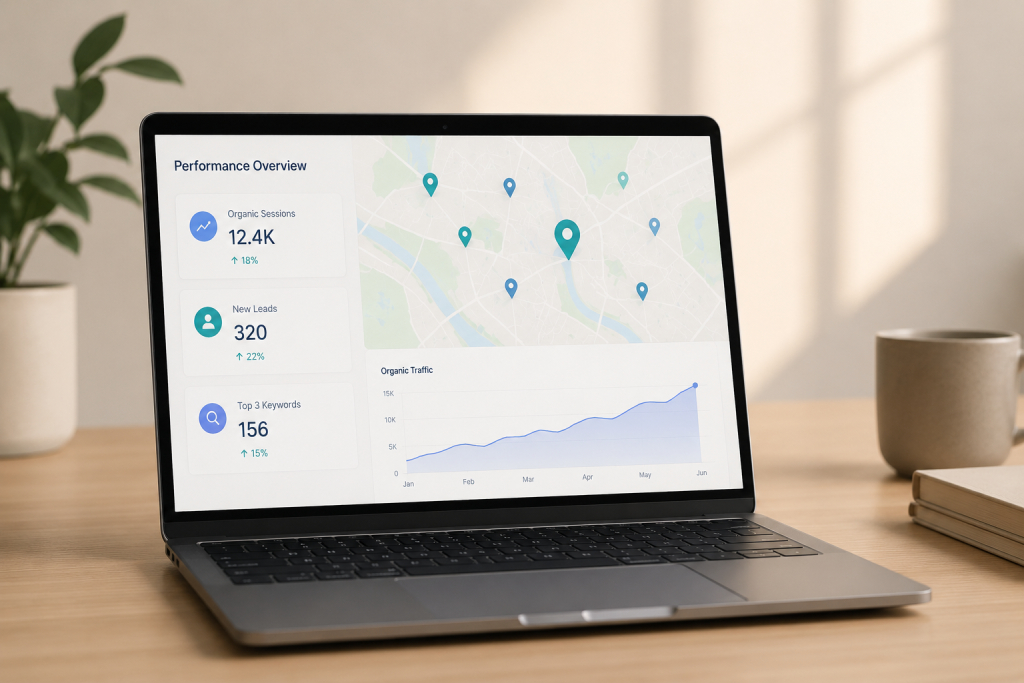
Local SEO is where real estate sites compete most directly with each other, and where the highest-intent leads originate. The SEO tips for real estate agents that actually shift rankings cluster around the Google Business Profile, reviews, and local citations, and the work compounds because Google rewards consistency over time.
Optimize Your Google Business Profile
Your Google Business Profile is the second homepage, and it deserves the same level of attention as the main site. The setup that ranks:
- Primary category as specific as possible (Real Estate Agent, Real Estate Agency, or Property Management Company), plus every secondary category that applies.
- Service areas filled out with the exact neighborhoods you cover.
- Plenty of photos (office, team, properties sold, community shots) with new uploads monthly to signal ongoing activity.
- Weekly Google Posts sharing new listings, market updates, and open houses.
- Fast responses to every review, with thanks for positive ones and composure plus a path to resolution for negative ones.
- Messaging enabled with fast replies during business hours.
A profile that gets weekly activity outranks a static profile in the same neighborhood almost without exception.
Build Local Reviews, Citations, and Backlinks
Reviews are the single strongest local ranking signal outside the profile itself, so build a system rather than running occasional campaigns. After every closing, send a personal follow-up with a direct review link (Google first, then Zillow, then Realtor.com), and time the request for the day of closing or the day after when goodwill peaks. Consistency matters more than bursts, since Google reads steady review flow as evidence of an active, healthy business.
Citations are mentions of your business name, address, and phone number across the web. The highest-value sources for real estate include Zillow, Realtor.com, Trulia, Homes.com, Redfin agent profiles, the National Association of Realtors directory, your regional association of realtors, Yelp, the BBB, and Apple Maps. Keep NAP identical across all of them.
Local backlinks come from local sources, and the best ones come from being involved in the community rather than chasing links directly. Sponsoring a youth sports team gets the website link. Hosting a first-time homebuyer workshop with a local credit union gets the partner page link. Quoting in the local paper on market trends gets the article link. Each one moves local rankings more than a pile of generic directory submissions ever will.
Measure Success and Avoid Real Estate SEO Pitfalls
Most real estate SEO tips focus on what to do, but the harder discipline is measuring what worked, catching what didn’t, and avoiding the quiet mistakes that drag rankings month over month while nobody notices.
Tracking Results With Google Analytics & Search Console
Google Analytics 4 and Google Search Console are non-negotiable, and both need to be configured before the first piece of content goes live. Search Console handles top queries, top pages, average position, click-through rate, indexing status, and Core Web Vitals, while
Analytics covers organic sessions by landing page, engagement rate, and conversion events like form submissions, phone clicks, valuation requests, and chat opens. The CRM closes the loop by tracking which organic leads actually turned into appointments, listings, and closings.
The full chain matters because a page pulling heavy traffic with no conversions is a problem worth solving, while a quiet page pulling a handful of qualified leads is a win that deserves more investment. Without the CRM tie-in, you cannot tell those two situations apart.
Common Mistakes: Keyword Stuffing & Duplicate Listings
Real estate sites tend to fail in the same predictable ways. Five mistakes show up most often:
- Keyword stuffing with variations of homes for sale, real estate, and houses for sale crammed into every paragraph until the page reads like spam, which Google’s systems catch quickly and demote.
- Duplicate listing content from MLS descriptions pulled straight to the site, leaving every IDX-enabled brokerage in the market with the same paragraph and no differentiation in Google’s eyes.
- Thin neighborhood pages built around a generic paragraph and a map, which outrank nothing and need to be replaced with substantial original local content.
- Ignoring mobile, where most property searches happen, since a site that’s hard to use on a phone loses leads silently with no error log to investigate.
- Setting and forgetting the site after launch, which lets sites audited once a year fall behind competitors refreshing their pages every quarter.
Does a Real Estate Company Need a Full-Time SEO?
The honest answer depends on volume and complexity. A solo agent with a handful of closings a year does not need a full-time SEO hire, while a brokerage with dozens of agents across multiple submarkets and an active content team probably does. The question of does a real estate company need a full time SEO really comes down to whether the work fills a full week, every week, throughout the year.
Most mid-sized brokerages land in the middle, with too much work for the marketing coordinator to handle on the side and not enough to justify a senior salary plus benefits. An agency or fractional SEO lead usually solves it more efficiently.
| Factor | In-House SEO | SEO Agency |
|---|---|---|
| Cost | Full salary plus tools and benefits | Monthly retainer scaled to scope |
| Speed to start | Several weeks to hire and ramp | A few weeks at most |
| Tool stack | Brokerage pays for Ahrefs, Semrush, Screaming Frog, and others | Included in retainer |
| Bandwidth | One person, full week | Full team across SEO, content, technical, and links |
| Industry knowledge | Deep on your brokerage | Broad across industries, often deep in real estate |
| Best fit | Larger brokerage with daily SEO needs | Solo agents through mid-sized brokerages |
How to Choose the Right SEO Partner
Hiring the wrong agency costs more than the retainer itself, because it costs the year of growth that didn’t happen while the wrong team was on the account. The right partner can point to real estate clients they’ve held for over a year, name the people who will actually do the work, walk through what the first ninety days look like, and explain how technical SEO, content, and link building come together rather than splintering across disconnected vendors.
The red flags are the inverse of all that, including guaranteed first-page rankings, generic monthly reports, link schemes built on PBNs or paid directory bursts, and any reluctance to share work product or tool access. A real partner shares context, explains decisions, and treats the domain as a long-term asset rather than a billable hour.
Real estate SEO works best when every part of the strategy connects: local keyword research, technical performance, neighborhood content, Google Business Profile activity, and lead tracking. If your site has traffic potential but no clear SEO system behind it, Unframed Digital can help turn that opportunity into a focused growth plan.
Frequently Asked Questions About Real Estate SEO
Can Solo Agents Compete With Zillow and Realtor.com?
Yes, on the right keywords. Solo agents win long-tail and hyperlocal searches like Berkeley bungalows under a million, where portals cannot match neighborhood-level expertise and original local content from someone who actually works the market.
Will IDX or MLS Feeds Cause Duplicate Content Issues?
Sometimes. Use canonical tags on IDX listing pages, rewrite descriptions on flagship properties, and noindex sold listings past their useful life. Google handles MLS feeds reasonably for well-structured sites with proper canonicalization.
How Do AI Overviews Affect Real Estate SEO?
AI Overviews answer informational queries like average closing costs in Colorado before users click through. Optimize content with clear answers, structured data, and authoritative sources to earn citations in those overview panels.
Should You Optimize for Addresses or Neighborhoods?
Neighborhoods, almost always. Address-level searches happen once per property and rarely repeat, while neighborhood searches happen daily and feed a steady pipeline of buyers researching where to live.