

Expanding into a new market starts you back at zero, in a fresh language, against local competitors who already rank. The multilingual SEO best practices in this guide close that gap by getting the right page, in the reader’s language, in front of the buyer before a competitor does. Most companies translate the copy and stop, setting aside the local keyword research, hreflang configuration, and cultural fit that decide whether a market converts.
Handled with discipline, one well-built site earns rankings across several languages and captures revenue competitors never reach. The framework below covers that work for 2026, from market selection through technical execution to AI visibility.
What Is Multilingual SEO?
Multilingual SEO is the practice of optimizing a website to rank in more than one language. The work spans translation quality, per-language keyword research, technical signals like hreflang, and locally earned authority.
Most teams reach this point when a single English site stops serving every customer, whether that is a Denver brand reaching Spanish-speaking buyers or a home-products company with European customers.
Multilingual SEO vs International SEO
Language and geography pose distinct targeting problems. Multilingual SEO organizes visitors by the language they read; international targeting organizes them by the country they occupy. The two overlap considerably, yet collapsing them into one signal is precisely where rankings begin to erode.
| Dimension | Multilingual SEO | International SEO | Global SEO |
| Primary signal | Language of the content | Country or region of the user | Both, plus brand strategy across all markets |
| Core question | What language does the reader use? | Where is the reader located? | How do we grow worldwide as one brand? |
| Typical mechanism | Language codes (en, es, de) | Region codes (en-US, en-GB), ccTLDs | Combined architecture and governance |
| Example | One Swiss site in German, French, Italian | Separate US and UK stores in English | A retailer running both across 12 countries |
| Best for | Multilingual countries and shared-language regions | Country-specific pricing, shipping, and law | Enterprises coordinating many markets |
A Swiss retailer illustrates the distinction cleanly. One country, three official languages, so the immediate priority is language coverage. Should that retailer expand into France and Germany, international targeting then layers on top, bringing country-specific pricing, shipping, and compliance.
When Businesses Need Multilingual SEO
In most cases, the analytics make the decision before leadership does. A few signals recur. Foreign-language visitors bounce fast, support tickets arrive in languages the site never publishes, and paid campaigns convert in regions where organic stays flat.
Three signals tend to confirm the need:
- A domestic market that operates in several languages, as in Canada, Belgium, or Switzerland.
- A single product sold across regions that share a language, where Spanish written for Spain reads differently than Spanish written for Argentina.
- A competitor consistently outranking you in-market with content produced by native speakers.
How Search Engines Understand Language and Regional Targeting
Search engines weigh several signals when deciding which version of a page to serve: declared language tags, hreflang annotations, the words on the page itself, server location, the country-code domain, and links from local sites. Among these, Google places the greatest weight on on-page language and hreflang.
When the signals align, the correct page surfaces for each query. When they conflict, Google is left to infer, and it frequently infers incorrectly.
Language Targeting vs Country Targeting
Language targeting addresses the language a reader speaks. Country targeting addresses where that reader is located. A page may do one without the other.
Consider a shopper in Mexico and a shopper in Spain. Both read Spanish, so language targeting alone would route them to the same page. Country targeting separates the two. The Mexican buyer sees peso pricing and domestic shipping, while the Spanish buyer sees euro pricing and EU returns. You set language with a code such as es and add region through es-MX or es-ES.
How Duplicate and Untranslated Content Confuses Search Engines
A half-translated page, with English boilerplate surrounding German body copy, gives search engines little to work with. The page ends up competing against your genuine English page for the same queries, and neither ranks well.
Near-identical language versions create a separate problem. When your Australian and British pages read almost the same, Google may elevate one and suppress the other.
Hreflang resolves the issue by identifying the pages as deliberate regional variants. Absent those tags, two legitimate pages compete, and rankings fragment between them.
Start With Market and Audience Research
Sound multilingual SEO begins with evidence, before the first word is translated. Teams that scale cleanly choose markets from data, then study how audiences there search. The work comes down to two decisions, which markets justify the investment and what search behavior looks like once you arrive.
Identify Priority Countries and Languages
Rank candidate markets by demand relative to effort. Existing international traffic in Google Analytics and Search Console reveals where interest already exists; from there, layer in market size, competitive density, and the cost of serving each region.
The strongest starting point is a market already sending signals. A US software company drawing steady sign-ups from the Netherlands and Brazil has its first two markets identified for it. A region with no traffic and entrenched local competitors is a heavier lift, and usually waits.
Analyze Local Search Behavior
Audiences in different markets express the same need in markedly different ways. Search volume, device preferences, dominant engines, and even query length vary by country. German compound nouns compress an entire phrase into a single word. Japanese searchers still direct meaningful share to Yahoo alongside Google. In South Korea, Naver shapes a large portion of content discovery.
Examine the live SERPs in each target language before you commit resources. The result formats Google rewards, whether a comparison table, a step-by-step guide, or a concise definition, indicate what you should build.
Conduct Keyword Research for Each Language
Keyword research does not carry across languages. Each language calls for original research, conducted in that language, using local tools and local data. Run an English keyword list through a translator and you end up targeting phrases no native speaker would ever type.
Why Direct Translation Fails
Translation exchanges one set of words for another. Search behavior rests on intent, slang, and habit, none of which a word-for-word swap captures. An American searches for cell phone while a British user searches for mobile, and a literal rendering serves neither well across English-speaking markets. In French, baskets refers to sneakers in France yet reads awkwardly in Quebec, where espadrilles is the natural choice.
Search volume diverges as well. A term drawing 50,000 monthly searches in English may have a strong equivalent in German and almost none in Dutch, even for an identical product.
Find Keywords Native Speakers Actually Use
Native input outperforms any tool. In-market speakers, customer support logs, and local keyword platforms reveal how people phrase their searches. Google’s autocomplete, set to the target language and country, surfaces authentic queries quickly.
A practical workflow runs as follows:
- Seed the list with translated terms, then treat each one as a hypothesis to test against local data.
- Validate volume in a platform holding local data, such as Ahrefs or Semrush configured for the target country.
- Confirm the phrasing with a native speaker who searches that way in practice.
Map Keywords to Search Intent by Market
Intent can shift across borders even when the keyword itself remains constant. A query that signals purchase intent in one market may signal early research in another, depending on how mature the category is locally. Insurance comparison reads as transactional in the UK, where comparison sites dominate, yet informational in markets where buyers still purchase directly through agents.
Group each market’s keywords into informational, commercial, and transactional intent, then map them to the page type that fits the dominant motivation. A single product may warrant a buying guide in one country and a product page in another.
Localize Content Beyond Translation
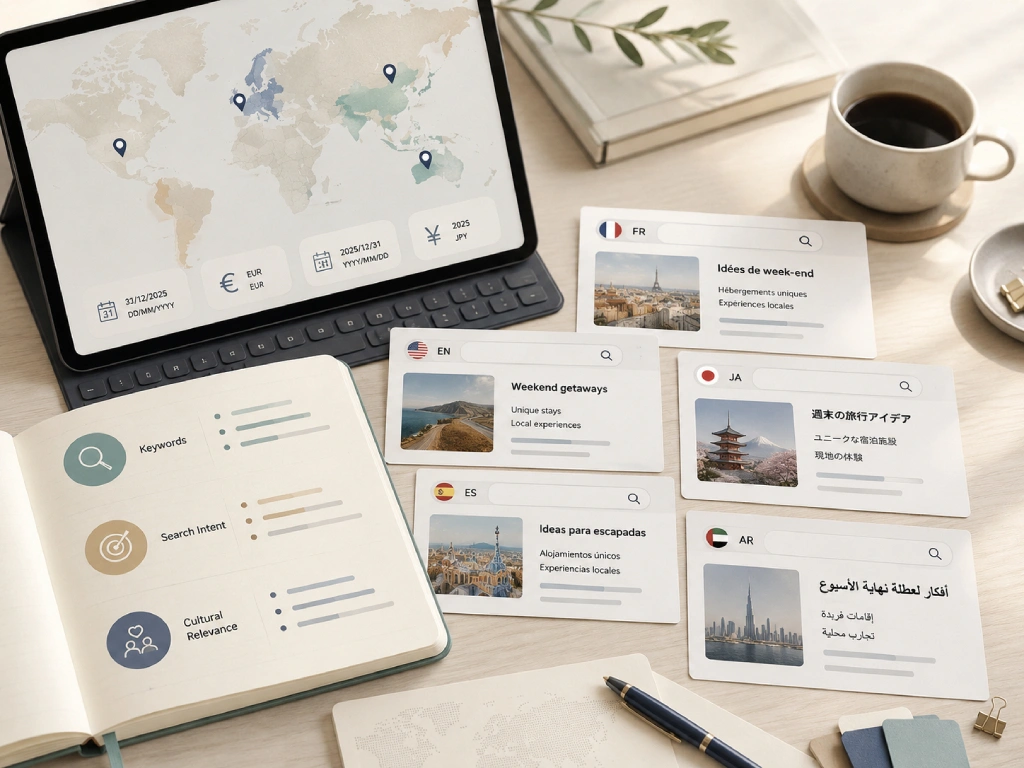
Translation renders a page readable. Whether it earns trust and a sale depends on localization, the work of fitting tone, examples, currency, and idiom to a specific audience. SEO localization is where accomplished multilingual programs separate themselves from brands that have merely been translated.
SEO Translation vs SEO Localization
SEO translations convert existing content into another language while preserving its keywords and structure. SEO localization goes further, reconstructing that content for a new market by adapting examples, pricing, cultural references, search terms, and voice to local expectations.
Consider a fitness blog. Translation converts lose weight before summer into the target language verbatim. Localization first asks whether summer functions as a motivator in that hemisphere at all, then rewrites the hook around the local calendar. The seasonal framing reverses entirely between Australia and Sweden.
Adapt Content for Cultural Relevance
Color, humor, imagery, and social convention carry uneven weight from one place to the next. A campaign built around baseball metaphors falls flat beyond North America. Payment expectations differ as well. Dutch shoppers expect iDEAL, German customers often prefer invoicing or direct debit, and many Brazilian buyers pay in installments even on modest purchases.
Smaller details signal whether you belong. Date formats, name order, the choice between formal and informal address in languages such as German or Japanese, and the examples you select all tell a reader whether the page was built for them or simply aimed in their direction.
Localize Images, Examples, and Calls to Action
Text is the obvious candidate for localization. The visuals and prompts around it influence conversion every bit as heavily. Replace imagery that reads as distinctly American with photography reflecting the local audience, and rework examples so a German reader sees euro figures and familiar German brands rather than dollars and US logos.
Calls to action deserve a dedicated pass. A direct Buy now that performs in the United States often feels abrupt in markets where buyers expect a gentler Learn more as the first step. Test the wording in each market rather than assuming the English version transfers.
Before a localized page goes live, confirm the following:
- Keywords researched natively rather than translated
- Currency, units, and date formats matched to the market
- Imagery reflects local people and settings
- Payment methods align with local preference
- Tone calibrated to local formality norms
- Calls to action adapted and tested per market
- Final page reviewed by a native speaker
Choose the Right URL Structure
URL structure is the foundation on which every other signal rests, which makes it a decision worth settling early. The choice influences how Google interprets geography, how much authority each version inherits, and how demanding the site is to maintain. For any company pursuing SEO for multiple countries, the stakes rise further, since the structure itself communicates where content belongs.
ccTLDs vs Subdomains vs Subdirectories
Each option communicates something distinct to search engines and users about where content resides. ccTLDs are country-code domains such as example.de or example.fr. They transmit the strongest geographic signal and confer immediate local trust, though each domain’s authority must be built and maintained independently.
Subdomains occupy a prefix, as in de.example.com. They separate markets cleanly under a single registered domain, even if authority does not always pass freely between them.
Subdirectories keep everything on one domain, as in example.com/de/. They concentrate authority on a single property and remain inexpensive to operate, which explains why most teams begin here.
| Structure | Pros | Cons | SEO Impact | Best Use Cases |
| ccTLD (example.de) | Strongest country signal, high local trust, clean legal separation | Costly to buy and run, authority split per domain, slow to build each | Each domain ranks on its own merit from a standing start | Large brands with budget and country teams |
| Subdomain (de.example.com) | Clear market separation, flexible hosting, one core domain | Authority sharing is inconsistent, heavier technical setup | Treated as semi-separate sites, so equity transfer is partial | Sites with distinct regional operations or platforms |
| Subdirectory (example.com/de/) | Inherits domain authority, cheapest to run, fast to launch | Weaker standalone geo signal, one domain carries all risk | Concentrates ranking power on one strong domain | Most businesses, especially early international targeting |
How to Select the Best Structure for Your Business
Match the structure to your resources and ambitions. For most companies starting out, subdirectories are the pragmatic choice. They launch fast, cost little to run, and keep hard-won domain authority working across every language. Enterprises take a different route. With dedicated country teams, local entities, and the budget to match, they often move to ccTLDs for the added trust and legal clarity.
A useful principle is to adopt the lightest structure that still meets your goals. Migrating from subdirectories to ccTLDs later is entirely feasible. Consolidating a sprawl of ccTLDs back into one domain is considerably harder, so resist over-building before traffic warrants it.
Implement Hreflang Correctly
Hreflang is the tag that prevents a multilingual site from competing against itself. Implemented correctly, it directs each searcher to the page matching their language and region. Implemented poorly, it ranks among the most common and persistent causes of international ranking issues. The mechanics are exacting, so precision is rewarded.
What Hreflang Does
Hreflang is an HTML attribute that informs search engines which language and region a page is intended for. It connects every version of a page to all the others, so Google can serve the Spanish page to a Spanish speaker and the German page to a German speaker, even when the underlying content is closely related.
The attribute sits in the page’s HTML head, the HTTP header, or the XML sitemap. Every version within a set must reference every other version, including itself, or the entire signal fails.
Hreflang Best Practices
Get the codes and cross-references right, and hreflang best practices largely take care of the signal. Use ISO 639-1 for language and ISO 3166-1 Alpha 2 for region, as in en-US or pt-BR. Include a self-referencing tag on every page, add an x-default for users who match no specific version, and keep all return tags bidirectional, since a one-directional reference is invalid.
Settle on a single implementation method and apply it across the entire site. Mixing head tags on some pages with sitemap entries on others tends to produce errors that are slow and frustrating to diagnose.
Before trusting a hreflang setup, verify the following:
- Language codes use ISO 639-1 (en, es, de)
- Region codes use ISO 3166-1 Alpha 2 (US, GB, BR)
- Every page references all versions, including itself
- Return tags run both ways
- x-default set for unmatched users
- One method sitewide, validated in a testing tool
Common Hreflang Errors to Avoid
Most hreflang problems trace back to a handful of recurring errors. Missing return tags lead the list. Page A references page B, B never references back, and Google disregards the pairing. Invalid codes follow closely, such as en-UK in place of the correct en-GB. Relative URLs used instead of absolute ones quietly undermine the references.
One error is especially easy to miss. A canonical tag pointing from your German page to your English page instructs Google to discard the German version altogether, which negates the hreflang setup. Audit canonical tags and hreflang in tandem, never separately.
Optimize Technical SEO Across All Languages

Technical SEO has to perform in every language you publish, English included. Crawling, metadata, sitemaps, and structured data each require a setup that accounts for multiple languages. Neglect this layer and even flawless translation underdelivers, because search engines never receive clean signals about what a page is or whom it serves.
Language Tags and HTML Attributes
The HTML lang attribute, declared in the opening html tag, communicates a page’s language to browsers and assistive technologies. Set it to reflect the content, for example lang=”de” on a German page. Google prioritizes visible content and hreflang over this attribute for ranking, yet accurate values still support accessibility tools and keep your markup consistent.
Keep the declared language and the actual content aligned. A page labeled French that delivers English body copy presents a contradiction no algorithm should be asked to reconcile.
Localized Metadata and On-Page Elements
Title tags, meta descriptions, headings, alt text, and slugs all require translation and native keyword research, rather than a direct copy of the English original. A meta description that converts well in English will often miss the precise phrasing local audiences search for.
Slugs warrant careful thought. Where it benefits readers and crawlers alike, translate the slug into the target language, so example.com/de/schuhe reads naturally to a German visitor. Keep it keyword-relevant in that language.
XML Sitemaps for Multilingual Websites
An XML sitemap helps search engines locate and interpret every language version. Listing hreflang annotations within the sitemap removes the markup from the page head and centralizes it in a single file.
Include all language and region URLs, keep the file current as new markets launch, and submit it through Google Search Console. On large sites, divide sitemaps by language and reference them from a sitemap index, so crawling remains orderly as page counts grow.
Structured Data for Localized Content
Structured data should reflect the language of the page it accompanies. Translate the values within your schema, product names, descriptions, and review text, so rich results render correctly in each market. Keep currency and availability accurate by region, since a euro price wrapped in dollar markup confuses Google and shoppers in equal measure.
Schema types remain constant across languages. The content within them is what localizes.
Optimize Multilingual Content for AI Search and AI Overviews
AI Overviews and assistant responses now appear above or alongside traditional results in many markets, and their behavior varies by language and region. Google assembles an AI Overview from sources in the language of the query, so English content will not appear for a German prompt regardless of how well it ranks in English. Each language version competes for citations independently.
Assistants such as ChatGPT, Gemini, and Perplexity draw from the content they can read and trust within a given language. Remaining citable in each market depends on the fundamentals, now more than ever: native-language content, clear structure, direct answers to genuine questions, and credible local sources that support your claims.
Several practices help pages earn AI citations across languages:
- Answer specific questions in the opening paragraph, in the local language, so a model can extract a clean passage.
- Publish authentic local expertise, since AI systems favor sources that demonstrate first-hand knowledge of a market.
- Earn mentions and links from trusted sites in each language, because local authority informs both search and AI.
- Keep facts, pricing, and statistics current by region, as outdated figures are filtered out.
Regional variation is pronounced. For the same question, an AI Overview will often cite entirely different sources in France and Canada, even within a shared language, because local relevance and authority differ. Treat AI visibility as an objective measured market by market.
Build Authority in Every Target Market
Rankings achieved in one market do not carry over to the next. A domain that dominates US search begins close to zero in Germany, because every market builds its own authority from scratch. Two levers raise it: backlinks from in-market sites and internal links that bind your language versions into a coherent whole.
Earn Local Backlinks
Links from sites within your target country and language carry the greatest weight for ranking there. A German .de site linking to your German pages signals local relevance in a way a US link never could. Pursue local press coverage, industry directories, partnerships, and guest contributions in each market’s language.
Locality and quality outweigh raw volume. Ten links from respected German publications contribute more to your German rankings than a hundred generic links from unrelated English-language sites.
Strengthen Internal Linking Between Language Versions
Internal links distribute authority and help search engines understand how your language versions relate to one another. A clear language switcher on every page allows readers and crawlers to move between versions, and it should link to the equivalent page rather than returning everyone to the homepage.
Within a single language, connect related pages to each other. A German blog post should link through to service pages written in the same tongue, so readers and link equity remain on one coherent path.
Measure Multilingual SEO Performance
Aggregate figures conceal more than they reveal in a multilingual program. Global totals obscure which markets are thriving and which are stalling, so segment everything by language and country from the outset. Effective reporting answers where you rank, what visitors do once they arrive, and where the next opportunity lies.
Track Rankings by Language and Country
Rankings vary substantially by location, so track them per target country and per language. A rank tracker configured for local engines and locations shows where each version lands within its own market.
Monitor keyword movement separately for each language. French keywords climbing while your Spanish set declines is precisely the kind of signal a blended report would conceal.
Monitor Traffic, Engagement, and Conversions
Traffic is where the story begins, not where it ends. Segment organic visits by language and region in Google Analytics, then examine the engagement and conversion behind them. A market delivering substantial traffic that never converts points to a gap in localization or intent.
Compare conversion rates across markets to locate where the experience falters. High bounce rates on your Italian pages, low time on page, and minimal sales together suggest the translation reads stiffly or the offer misses local expectations.
Identify Localization Opportunities
Your data steadily points toward the next worthwhile investment. A page accumulating impressions but few clicks in a given market typically needs a sharper localized title and description. Keywords lingering on page two in one language often become quick wins after a focused local refresh.
The country and query filters in Search Console expose demand you have yet to serve. When German users find you through queries you never targeted, that gap becomes your next content brief.
Common Multilingual SEO Mistakes
A predictable set of mistakes undermines most multilingual programs, and each is avoidable once the pattern is recognized. Address them early and you spare yourself months of stagnant results.
Using Machine Translation Without Review
Raw machine translation publishes quickly and reads poorly, often more poorly than almost anything else you might put live. Modern engines manage the gist, then falter on idioms, tone, industry terminology, and the precise keyword phrasing locals depend on. Google does not penalize machine translation outright, yet it does target low-quality, unhelpful content, which untouched output frequently becomes.
Treat machine output as a first draft, then assign a native editor to every page. The modest cost of review is trivial against losing a market that quietly decides never to trust you.
Targeting Multiple Countries With One Version
A single English page cannot adequately serve the US, UK, Australia, and Canada at once. Spelling, currency, terminology, and purchasing habits differ across all four, and one generic version satisfies none of them completely. More damaging still, near-duplicate requirements are forced onto a single page that then ranks weakly everywhere.
Build distinct versions with hreflang region codes when markets share a language yet differ in the details. The additional pages justify themselves through sharper relevance in each country.
Ignoring Local Search Intent
A keyword may carry one intent at home and another abroad, and overlooking that shift wastes otherwise strong content. Buyers in one market act on a term that signals research in another, so page type should follow local intent rather than a home-market assumption.
Review the live SERP in each target market before deciding on format. When Google surfaces comparison tables and buying guides for a term in Spain, a thin product page will not compete.
Building a Scalable Multilingual SEO Strategy
Real results come from applying these multilingual SEO best practices as one connected effort. The research and on-page work that ground each market, the technical and authority signals that earn rankings and AI visibility, and the measurement that catches mistakes early all pull in the same direction. Each language version is a market of its own, and the work succeeds and scales when everyone is built that way.
Expanding into new languages goes better with people who already know how those markets search. That is the work Unframed Digital does, with native-speaker strategists and copywriters for the markets you’re entering. When you’re ready to plan your next market, get in touch.
Frequently Asked Questions About Multilingual SEO
What Is the Difference Between Multilingual SEO and Global SEO?
Multilingual SEO optimizes content by language, while global SEO is the broader strategy coordinating every market, language, and country into one worldwide approach to organic growth.
Can You Use Machine Translation for SEO?
Yes, but only as a first draft. Machine translation misses idioms, tone, and local keywords, so a native editor must review every page before you publish it.
Which URL Structure Is Best for Multilingual SEO?
Subdirectories suit most businesses, since they inherit domain authority and launch fast. Large enterprises with country teams and budget often choose ccTLDs for stronger local trust.
Do You Need Hreflang for Every Language Version?
Yes. Every language and region version should carry hreflang tags referencing all others, including itself. Without complete, bidirectional tags, search engines may serve the wrong page or none.