

For enterprise companies, a single ranking change ripples across thousands of pages, and that cumulative drop hits the quarterly revenue number. With stakes that high, the question almost asks itself: do enterprise companies need SEO in 2026? For a large site, the answer is an easy yes, even as AI Overviews and paid search compete for the same clicks. Organic search still reaches buyers at the point of decision, and it does so without paying for every visit. Managed well, search engine optimization becomes the channel leadership counts on.
What Enterprise SEO Really Means
Enterprise SEO is the practice of improving organic search performance across large websites that hold thousands or millions of pages, span multiple markets, and involve several internal teams. The work covers technical health, content at volume, and the governance needed to keep quality consistent as the site grows.
A large retailer with a sprawling product catalog faces different problems than a local plumber with a handful of pages. At that size, small errors multiply fast. One broken canonical rule applied site-wide de-indexes entire categories overnight. SEO for enterprise companies treats search as an operations problem as much as a marketing one, with process, prioritization, and measurement built for scale.
How Enterprise SEO Differs from Traditional SEO
Traditional SEO and enterprise SEO share the same fundamentals: relevant content, clean technical SEO structure, and links that signal authority. The difference is scale and everything scale drags along with it: more pages, more stakeholders, stricter governance, heavier tooling, and far more risk riding on a single change. The table below compares the two across the factors that matter most.
| Factor | Traditional SEO | Enterprise SEO |
| Scale | Tens to hundreds of pages | Thousands to millions of pages across markets |
| Stakeholders | One marketer or a small team | SEO, dev, legal, brand, product, and regional owners |
| Governance | Informal, fast to change | Formal approval workflows, style and schema standards |
| Tooling | A single SEO tool, manual checks | Enterprise platforms, crawlers, log analysis, automation |
| Risk | A bad change hurts a few pages | One bad rule affects revenue site-wide |
When Traditional SEO Breaks
Tactics that work on a small site fall apart at volume. Editing pages by hand is fine for a few dozen URLs and impossible across a large catalog. A spreadsheet of target keywords stops being useful once several regional teams each own their own sections.
Traditional SEO breaks at predictable points: when manual work no longer scales, when no single person sees the whole site, and when one group’s edit quietly breaks another’s pages. An enterprise approach replaces guesswork with systems, so a title-tag update or a schema fix rolls out safely across templates rather than page by page.
The Business Case for Enterprise SEO
Budget conversations at this level come down to one question, does the channel protect or grow revenue we measure? Organic search does both, and at scale the numbers get large enough that leadership pays attention. Below is the case, broken into the parts that land with a CFO.
Search Visibility Is Never Guaranteed at Enterprise Scale
Rankings move. Algorithms update several times a year, competitors invest, and Google reshuffles results without warning. A page holding position two today slips to page two within months if nobody maintains it.
For a large site, that volatility multiplies. Thousands of pages each carry their own ranking risk, and a quiet drop across a major product category drains revenue long before anyone notices. Steady enterprise SEO keeps that visibility defended, with monitoring that flags declines while they are still cheap to fix.
Paid Media Alone Cannot Protect Market Share
Paid search delivers traffic the moment you fund it and stops the moment you don’t. When you pause the budget, the visibility disappears with it. For categories where you want to own the conversation year-round, that model gets expensive and fragile.
Search works best when both run together. Paid covers launches, promotions, and short-term gaps in coverage. Organic builds the durable visibility that holds cost-per-acquisition down over time. That balance works best when organic pages are mapped to search intent rather than traffic volume alone. The table below shows where each channel earns its keep.
| Factor | SEO | Paid Media |
| Cost over time | Compounds, cost per visit falls as rankings hold | Recurring; cost per click rises with competition |
| Traffic when budget stops | Continues | Stops immediately |
| Time to results | Weeks to months | Same day |
| Trust and click-through | Higher for organic listings and AI citations | Lower; users often skip ads |
| Best use | Durable demand and category ownership | Launches, promotions, and fast tests |
Revenue-Relevant Organic Traffic and Conversions
Traffic only counts when it converts. A million visits to pages that never lead to a sale tell you little. The value sits in organic sessions that reach buyers ready to act.
Picture a B2B software company that ranks for “contract review software for construction.” The searcher already understands the problem and wants a tool. Intent like that converts far better than a broad term such as “software.” Enterprise-level SEO maps content to those high-intent queries, then tracks the pipeline and revenue each query drives, not the raw click count.
Better User Experience at Scale
Google rewards sites that load fast, work on phones, and guide people to what they came for. At this size, those signals also shape how millions of real visitors feel about your brand.
A faster category page lifts rankings and conversions at the same time. Clear internal links guide a shopper to the right product and help crawlers read your site. Strong technical SEO and good UX pull in the same direction, so the work you do for search pays off twice.
Visibility in AI-Powered Search
AI Overviews, ChatGPT, and Perplexity now answer questions that used to start with a blue link. People read the summary and act on it, often without clicking through. For large brands, absence from those answers means absence from the decision.
The good news: AI systems pull from the same well-structured, authoritative content that ranks in classic search. Clean schema, clear headings, and trustworthy sources make your pages quotable to a model. Enterprise SEO in 2026 plans for both the ten blue links and AI search optimization work that now sits on top of them.
Core Components of Enterprise SEO
The discipline breaks into four working parts. Each matters on its own, and the program holds together only when they run as a system.
Technical SEO at Scale
Technical SEO is the foundation. It covers crawlability, indexation, site speed, and structured data across every template. On a large site, you fix problems at the template level, not the page level, so one correction reaches thousands of URLs at once.
Common priorities include crawl budget control, clean canonical rules, fast Core Web Vitals, and log-file analysis to see what search engines actually fetch. Get the foundation wrong and even excellent content stays invisible.
Scalable Content Strategy
Writing one great article is easy. Producing thousands of accurate, on-brand pages across markets and keeping them current is the real challenge. A scalable content system sets templates, briefs, and quality standards so volume never sinks quality.
A strong SEO content strategy combines pillar pages for broad topics, supporting pages for specific queries, and a refresh schedule that keeps existing content alive. For multilingual brands, it also means real localization, not machine translation dropped onto a page and forgotten.
Governance, Reporting, and ROI
Governance keeps a large SEO program from descending into chaos. With dozens of contributors touching the site, you need rules for who approves changes, which standards apply to schema and metadata, and how new pages get reviewed before launch.
Reporting closes the loop. Leadership wants to see organic revenue, pipeline, and share of voice, not a list of keyword positions. Strong governance plus clear reporting turns enterprise SEO from a cost center into a line item the business defends.
Automation and Enterprise SEO Tools
Manual work hits a ceiling fast at this scale. Platforms like Conductor, BrightEdge, Botify, and Ahrefs handle the volume, crawling millions of URLs, monitoring rankings across markets, and flagging issues the moment they appear.
Match the platform to the bottleneck. A crawler like Botify earns its keep on indexation at scale, a visibility suite like Conductor or BrightEdge on cross-market monitoring and reporting, and a research tool like Ahrefs on sizing opportunities. The right platform saves analyst hours; it does not just add another dashboard nobody reads.
Automation absorbs the repetitive load, so your team spends its hours on strategy and judgment. Automated alerts catch a sudden de-indexing event overnight. Bulk reporting frees an analyst from copy-paste duty. The point of these platforms is leverage: more coverage from the same headcount.
How to Build an Enterprise-Level SEO Strategy
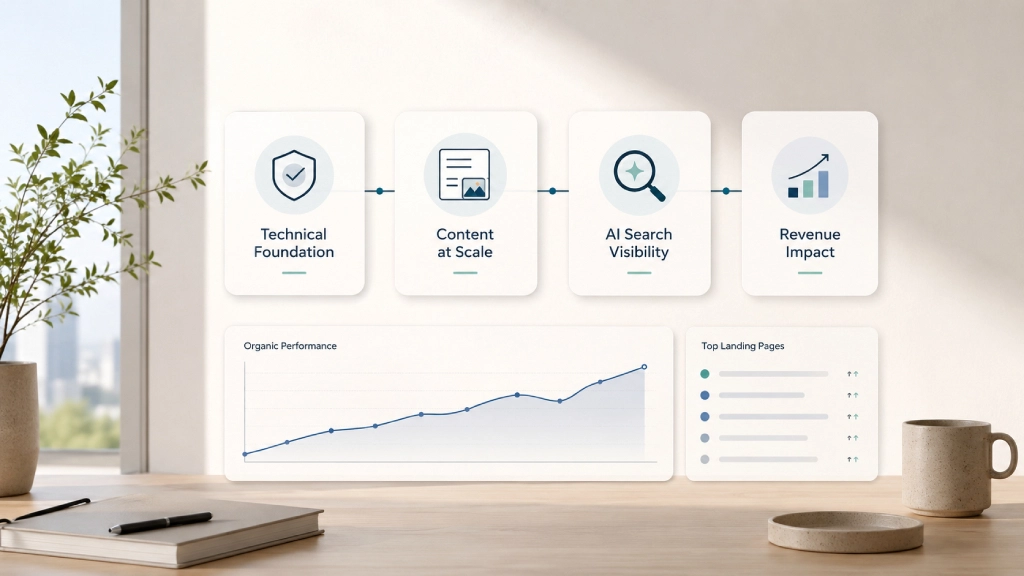
A strong enterprise-level SEO program moves in order: understand where you stand, decide what to fix first, build systems to execute, and then measure what it returns. The four steps run as a continuous loop, not a one-time project.
Step 1: Audit Technical and Content Performance
Start with a website audit that gives you a full picture of the current site. A technical crawl surfaces broken links, indexation gaps, slow templates, and duplicate URLs. A content audit shows which pages earn traffic, which sit dormant, and which compete with each other for the same term.
The audit gives you a baseline and a ranked list of problems. Without it, you are guessing, and at that volume guesses get expensive.
Step 2: Prioritize High-Impact SEO Opportunities
Nobody fixes everything at once, so rank the work by impact and effort. A template fix that lifts thousands of pages beats a hand-edit on one. A high-volume category sitting one position below the fold deserves attention before a term nobody searches.
Score opportunities on potential traffic, revenue, and effort, then sequence them. Good prioritization is where SEO for enterprise earns much of its return, because it points limited resources at the changes that pay.
Step 3: Build Scalable Content and Workflow Systems
Execution at scale needs systems, not heroics. Build content templates, clear briefs, approval workflows, and a publishing calendar that several teams follow without tripping over each other.
The need is the same everywhere, a repeatable path from idea to live page that holds quality steady at volume. Document the process once, train against it, and the output no longer depends on any single person.
Step 4: Measure Business Impact Beyond Rankings with an ROI Framework
Rankings are a means, not the goal. Tie SEO to money with a framework leadership recognizes. A workable enterprise SEO ROI framework tracks four layers:
- Visibility: rankings, impressions, and share of voice in both classic and AI search.
- Traffic: organic sessions, weighted toward high-intent, revenue-relevant queries.
- Conversions: leads, sign-ups, or sales attributed to organic.
- Revenue and ROI: organic revenue against program cost, expressed as a clear return.
Report the top of that stack to your team and the bottom of it to your board. The connection between a schema fix and a revenue figure is what keeps the budget funded.
Common Enterprise SEO Challenges
Most large-scale programs hit the same walls. Knowing them ahead of time makes them easier to clear.
Duplicate, Thin, or Outdated Content
Large sites accumulate clutter. Old campaign pages, near-identical product variants, and thin category descriptions pile up over years and dilute the authority of the pages you actually care about.
The fix is a content inventory followed by clear decisions: consolidate duplicates, improve thin pages, and retire or redirect the dead weight. A leaner, stronger set of pages outranks a sprawling, neglected one.
Legacy Website Platforms
Many enterprises run on a CMS chosen a decade ago, and it fights back when you try modern SEO. Maybe it refuses to output clean structured data, or every URL change needs a developer ticket and a slow trip through the dev queue.
Two paths usually open up: work within the platform’s limits using whatever flexibility exists, or make the business case for re-platforming. Either way, name the constraint early so it shapes the roadmap instead of derailing it.
Inconsistent Measurement Across Teams
When the SEO team, the regional sites, and paid media each define success differently, nobody trusts the numbers. One counts sessions, another tracks conversions, a third reports rankings, and leadership hears three stories about the same channel.
Agree on shared definitions, one source of truth, and a single dashboard everyone reads. Consistent measurement looks less glamorous than a ranking win and proves far more useful once the budget gets questioned.
How to Choose an Enterprise SEO Partner
The right partner for SEO for enterprise companies looks different from a freelancer or a small local agency. You are hiring for scale, process, and judgment to work inside a complex organization. A few traits separate the agencies that deliver from the ones that overpromise.
Enterprise Website Experience
The first thing to check is whether they have managed sites your size. A team used to small-business projects will drown in a large-scale migration. Enterprise work demands experience with crawl budgets, faceted navigation, internationalization, and the politics of large teams.
A credible agency offers case studies at comparable scale, references you call directly, and a clear account of a hard problem they solved. Vague claims of expertise rarely survive a specific question.
Transparent Prioritization and Reporting
Strong partners show their work. They explain why a particular fix ranks first, what return they expect, and how they will prove it. You should always see the roadmap, the rationale, and the results in plain numbers.
Be wary of black-box promises and reports full of activity but light on outcomes. Transparency builds trust across a multi-year engagement, and enterprise SEO is rarely anything shorter.
AI Search Optimization Capabilities
In 2026, a partner who ignores AI search is behind. Ask how they approach AI Overviews, how they structure content to be cited by language models, and how they track visibility inside answer engines, not only classic rankings.
The strongest agencies already fold generative engine optimization into their standard work. They treat a citation in ChatGPT or an AI Overview as a ranking that matters, because for your buyers it now does.
What Enterprise SEO Delivers When It’s Done Right
A mature program compounds. Solid technical foundations and consistent content turn organic search into one of the most efficient sources of qualified demand a large business has. The payoff shows up where leadership looks: steadier organic revenue, higher conversions from search, and market share that holds over time. For a large company, that combination becomes a durable advantage that competitors find difficult to replicate.
If your organic performance has plateaued or your site has outgrown its current setup, start with an audit. Share your domain and we will show you where rankings and revenue are slipping and what an enterprise SEO program at your scale would take to fix it.
Enterprise SEO FAQs
How Long Does Enterprise SEO Take?
Expect early technical wins within three months and meaningful traffic gains in six to twelve. Enterprise SEO compounds over years, so the largest returns arrive after sustained, consistent work.
Is Enterprise SEO Worth the Investment?
Yes, for most large sites. Organic search reaches high-intent buyers at a cost per acquisition below paid media, and the visibility you build keeps returning value long after the spend.
Should We Manage Enterprise SEO In-House or Work with a Partner?
Many enterprises do both: an internal lead owns strategy while a partner supplies scale and execution. Full in-house works when you have the talent and budget to staff it properly.
How Do We Measure and Prove the Real ROI of Enterprise SEO?
Attribute organic sessions to conversions and revenue, then weigh the result against program cost. Track visibility, traffic, conversions, and dollars as one chain so the board sees money, not rankings.