
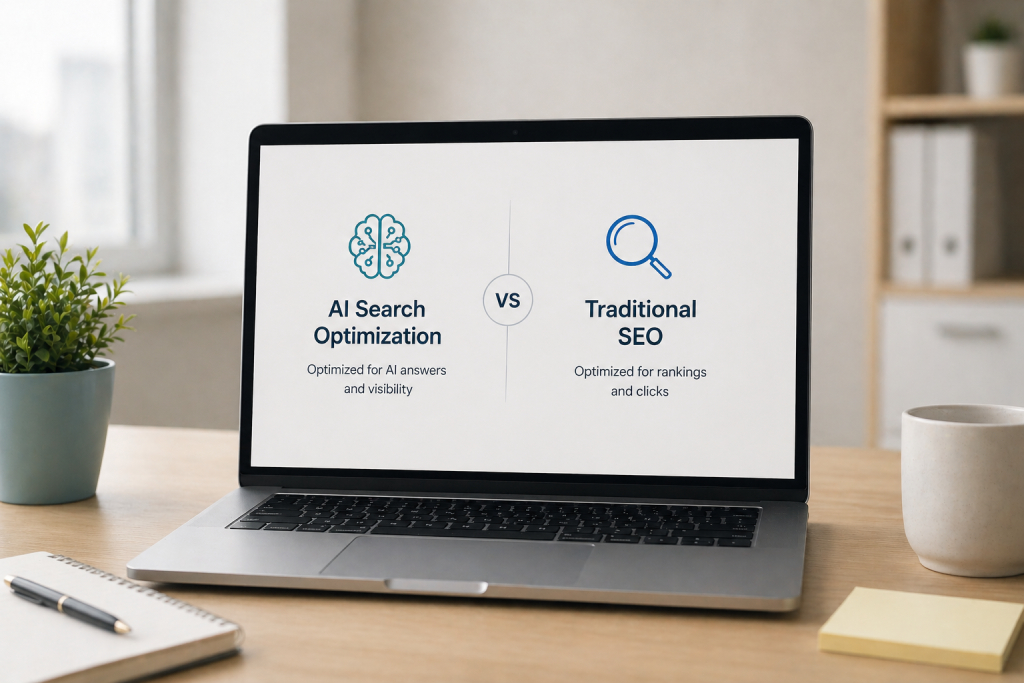
For years, search meant scrolling through ten blue links until you found the right one. Now, AI and SEO often overlap because users can get a direct answer without clicking the source. That shift is what AI search optimization vs traditional SEO is really about.
Ranking on Google still matters. But if your brand isn’t showing up inside ChatGPT, Perplexity, or Google’s AI Overviews, a growing share of your audience never sees you. This guide walks through where the two approaches diverge, where traditional SEO still wins, and how to adapt your existing strategy.
What Is Traditional SEO?
Traditional SEO is the process of optimizing a website to increase its visibility in search engines such as Google and Bing. It relies on a system where a user types a query, the engine returns a page of blue links, and the user chooses which one to click. Optimization here involves technical health, keyword placement, and building a network of backlinks. Success means reaching the top three spots on the first page because most clicks happen there.
What Is AI Search Optimization?
AI search optimization positions a brand as the preferred source for large language models. Modern chat tools provide a direct answer instead of a list of results and turn your site into a vital knowledge base. Following this method ensures the business stays relevant even when people stop using classic browsers.
Answer Engine Optimization (AEO)
AEO prepares content for direct-answer surfaces like AI Overviews, voice assistants, and Featured Snippets. It prioritizes providing immediate responses to who, what, where, and why questions. Clear data and concise definitions are the currency here. If a user asks for a specific fact, AEO ensures your site provides the single best answer the engine can find.
Generative Engine Optimization (GEO)
GEO takes things further by optimizing for generative AI platforms that summarize complex topics. These engines look for expert opinions and unique data to include in their long form responses. While AEO handles simple facts, GEO focuses on depth and context. Proper optimization involves structuring your site so an AI can easily credit your brand as the authority behind a specific insight or recommendation.
Where AI SEO and Traditional SEO Diverge
The primary AI SEO vs traditional SEO differences come down to how users get information and how brands measure visibility. The sections below break those differences down one by one.
Discovery and Search Results
In traditional search, discovery happens when a user scans a results page. They see your title and meta description before deciding to visit. AI search removes this step by delivering the information directly. Discovery happens within the AI’s response itself. If your company isn’t mentioned in the chat, the user may never know you exist, even if you rank first on Google for that topic.
Keywords, Prompts, and Topics
Traditional SEO targets specific keywords with high search volume. You might optimize for best laptop for designers and track that exact phrase. AI search optimization vs traditional SEO shifts the focus toward user prompts and intent. People talk to AI in full sentences or vague follow up questions. Optimization now requires covering a topic so thoroughly that you can answer any variation of a prompt, regardless of the specific words used or the user’s search intent.
Content Structure and Answers
Search engines like organized headers and meta tags. AI tools prefer content that mirrors how humans talk and teach. A traditional blog post might bury the lead to keep readers scrolling. Clear layout allows the model to grab the necessary snippet without having to parse through paragraphs of introductory fluff.
Authority, Links, and Mentions
Backlinks have always been the backbone of Google’s algorithm. While links still matter, AI engines look for brand mentions and citations across diverse platforms. They crawl social media, forums, and news sites to see who people are actually talking about. Being discussed on a podcast or cited in a community forum can carry as much weight for an AI as a standard guest post link.
Metrics and Performance Tracking
The old metrics were built for click-based search. They don’t capture what matters when the answer gets delivered inside a chat and the user never visits your site. Success now means showing up inside the AI’s response, not driving the click, and most standard SEO reports aren’t set up to measure that yet.
| Category | Traditional SEO | AI Search Optimization |
| Main Metric | Click through rate | Brand share of voice |
| Data Source | Search Console | Mention tracking |
| Success Sign | Page 1 ranking | Direct citation |
Where Traditional SEO Still Wins

Despite the rise of AI, traditional SEO vs AI search optimization isn’t a zero sum game. There are still many areas where a classic search engine is the better tool for the job and where standard optimization remains unbeatable.
Commercial and Transactional Queries
When someone is ready to buy, they usually want to see options, prices, and photos. AI is great for advice, but it’s often slower for shopping. A user looking for red running shoes size 10 wants a grid of products they can filter and buy immediately. Traditional SEO ensures your online retail categories and product pages appear exactly when that high intent buyer is searching.
Local Search and Map Pack Visibility
If you need a plumber right now, you don’t ask an AI for a 500 word essay on leak detection. You look at the Google Map Pack to find someone nearby with good reviews. Local SEO relies on physical proximity and directory consistency. AI tools still struggle to provide immediate, hyper local service recommendations as accurately as a dedicated map interface.
Long-Tail Content That AI Tools Skip
AI models are trained on existing data, which means they often generalize. They might miss the nuance of a very niche long tail problem. For example, a specialized software developer looking for a specific line of code for a 10 year old framework will find more value in a detailed forum post or a technical blog. Humans still create the deep dive content that AI eventually summarizes.
How to Adapt Your SEO Strategy for AI
Balancing your approach requires a few tactical shifts, especially if you already have a broader SEO strategy in place. You don’t need to throw away your old playbook; you just need to add a few new chapters that cater to how machines read and summarize.
Step 1: Build Strong SEO Foundations
AI models often pull from the top ranking results in traditional search. If your site is slow or broken, AI tools likely won’t find it either. Maintain your technical SEO, keep your sitemaps updated, and ensure your site is easy to use on a phone. A solid foundation is the minimum requirement for any type of digital visibility.
Step 2: Research the Prompts People Ask AI Tools
Stop looking only at keyword volume and start looking at conversational prompts. Use tools to find out what questions your customers are asking ChatGPT or Claude. A roofing contractor might find that instead of searching “roof repair,” people are asking “how do I know if my shingles have hail damage?” Writing content that answers these specific prompts, especially as part of organized topic clusters, makes you a prime candidate for AI citations.
Step 3: Structure Content for AI Answers
AI models don’t read your page top to bottom the way a human does. They scan for extractable blocks, clear definitions, numbered steps, and structured data that can be lifted cleanly into an answer. A few simple formatting habits make your content far easier to cite:
- Define terms clearly at the start of sections.
- Use bulleted lists for steps or features.
- Include a summary table for topics with data.
Step 4: Add Expertise, Evidence, and Clarity
Most sites say the same thing as everyone else, which is exactly why AI models can summarize them interchangeably. The way to stand out is to say something only you could say. If you’re a financial advisor, don’t only explain what a 401k is. Share a specific example of how a client optimized their portfolio during a high inflation year. Unique insights are what AI engines value most when they choose which source to cite.
Step 5: Earn Mentions and Citations Across the Web
To actually earn the kind of mentions AI models weigh, work three channels in parallel:
- Pitch your team as sources to industry publications and journalists covering your space.
- Answer questions in niche community forums where your audience already spends time. Don’t drop links, build a reputation first.
- Build a podcast and webinar circuit for your founders or senior experts. One good episode tends to get referenced across multiple platforms.
Step 6: Track Rankings, Mentions, and Leads
Google Search Console doesn’t yet isolate AI Overviews in its own filter, but the data is there. Long, conversational queries in your Performance report are a strong proxy for AI-style prompts, and Google Analytics can isolate referral traffic from AI tools if you segment it properly. Beyond the platforms, manual prompt testing is still the most reliable way to see whether your brand is being cited for the queries that matter.
| Reporting Source | Data Point to Watch | Why it Matters |
| Search Console | Long-form query filter | Proxies AI-style prompts your content ranks for |
| Google Analytics | Direct traffic | Captures users visiting after an AI chat |
| Brand Trackers | Mentions | Measures share of voice across conversational tools |
AI Search Optimization Checklist
A checklist won’t replace the work, but it’ll catch the gaps. Run through these before you publish anything new or push a page live:
- Direct Answers: Does every informational page answer a specific question within the first two paragraphs?
- Schema Markup: Are you using technical code to tell search engines exactly what your content represents?
- Natural Language: Does your writing sound like a person explaining a concept to a friend?
- Citations: Are you quoting external experts and linking to high quality sources?
- Unique Value: Does your content offer something an AI couldn’t simply hallucinate or guess?
- Brand Presence: Is your company information consistent across LinkedIn, Crunchbase, and your About page?
Common Mistakes to Avoid
Transitioning your strategy can lead to some common pitfalls. Avoiding these errors ensures you don’t lose your current rankings while trying to chase the next big thing.
Overusing AI Content
Using AI to write all your content is a recipe for invisibility. If your site looks exactly like every other AI generated page, search engines and AI models have no reason to prefer you. Readers can sense when a person isn’t behind the words. Authentic writing remains the only way to build true authority and trust.
Ignoring Technical SEO
Some believe that AI is so smart it can figure out a messy website. The reality differs from that belief. Broken links, poor navigation, and slow load times still frustrate the bots that crawl your site. Technical health is the language search engines use to understand your structure. If that language is garbled, your content won’t be indexed or summarized correctly.
Optimizing Only for Keywords
Focusing purely on AI SEO vs traditional SEO as a keyword string ignores the intent behind the search. People want to understand how to change their marketing budget or which tasks to automate. If you stuff keywords into a page without building semantic SEO relevance, you might rank for a week, but you won’t stay there. User satisfaction is the ultimate metric for every engine.
Final Thoughts on AI SEO vs Traditional SEO
AI search hasn’t replaced SEO. It’s pushed SEO into new territory. Google still drives most transactional traffic, and traditional optimization is what gets you there. But early-stage research is shifting. More of it now happens inside AI-generated answers, and brands that aren’t cited in those responses quietly lose visibility. The brands that stay visible are the ones investing in both channels, not choosing between them.
Frequently Asked Questions
Is Traditional SEO Still Worth It?
Yes, traditional SEO remains the primary driver of web traffic for online retail. Google still handles billions of standard searches every day, where users prefer browsing results.
What Tools Track AI Search Visibility?
Platforms like Ahrefs and Semrush are adding AI tracking features, and dedicated tools like Profound and Peec AI monitor brand citations across ChatGPT and Perplexity.
How Long Does AI SEO Take to Work?
It depends on the tool. Perplexity and Google AI Overviews use live search and can cite new content within days. ChatGPT only updates through retraining, so visibility there takes months.
Do You Need Separate Strategies for SEO and AI Search?
Not necessarily. A high-quality content strategy naturally serves both. Clear, expert-led writing that answers user questions will rank in Google while also being picked up by AI engines.