

Public relations hasn’t disappeared.
Instead, it has evolved.
Today, both traditional PR and Digital PR still play meaningful roles in how brands earn attention. However, the difference between them is no longer about quality, legitimacy, or whether coverage is “real.” Rather, it comes down to intent, longevity, and how visibility is evaluated in a search- and AI-driven world.
Understanding this distinction helps brands avoid relying on tactics that no longer support how buyers discover, evaluate, and trust expertise. Just as importantly, it explains why some PR efforts fade quickly, while others continue influencing visibility long after publication.
With that context in mind, let’s take a closer look at how PR works today—and why the difference matters more than ever.
Why This Distinction Matters Today
Not long ago, PR success could be measured by presence alone. A feature in a major publication, a broadcast mention, or a well-placed quote signaled credibility and reach. In most cases, visibility peaked during a specific moment or campaign window, and that was enough.
However, discovery no longer works that way.
Today, buyers research independently long before engaging with sales. They compare brands within search results, read third-party perspectives, and increasingly rely on AI tools to summarize expertise. In many cases, opinions are already forming before a brand ever enters a direct conversation.
At the same time, search engines now surface answers instead of providing lists of links. AI systems synthesize and present information by identifying patterns across credible, third-party sources.
As a result, PR now influences far more than reputation alone. It shapes how brands appear in search results, which experts are referenced by AI tools, and how authority is recognized over time.
This shift doesn’t make traditional PR obsolete. Instead, it changes what success looks like, and what PR is expected to support.
Traditional PR: Narrative and Reputation Building
To start, traditional PR remains valuable when the goal is shaping perception, building awareness, or managing high-visibility moments. Its core strengths lie in storytelling, message control, and long-standing relationships with journalists and editors.
Typically, coverage is evaluated through reach, impressions, sentiment, and message alignment. These indicators are especially useful during launches, announcements, executive positioning, or crisis communication, where consistency and credibility matter most.
That said, traditional PR often struggles to answer a different set of questions:
- Does this visibility persist beyond the initial placement?
- Does it influence how the brand is discovered later?
- Does it support how credibility is evaluated within digital channels?
Because traditional placements are frequently tied to specific publication cycles or broadcast windows, their impact can be difficult to extend. Visibility may spike, then taper off, without meaningfully contributing to long-term discoverability.
In short, for awareness and reputation management, traditional PR still plays an important role. For sustained visibility in search- and AI-driven environments, it has clear limits.
Digital PR: Visibility Designed to Last
Unlike traditional PR, Digital PR takes a longer-term view of visibility by focusing on earned media: third-party coverage such as journalist mentions, citations, and editorial links that brands receive organically based on relevance and expertise, rather than through paid placements or owned channels.
Instead of treating these placements as isolated wins, Digital PR treats them as visibility assets. Mentions, citations, and expert insights are intentionally aligned with how search engines and AI systems evaluate authority, ensuring that coverage continues to work beyond its initial publication.
This approach looks past placement alone and focuses on how stories are indexed, referenced, and connected to broader subject areas.
Over time, these signals shape brand visibility in search results, industry research, and AI-generated answers, long after the original article goes live.
Why Earned Media Strengthens Domain Authority
Because Digital PR placements live online, they often include contextual links back to relevant brand content. Over time, these backlinks contribute to stronger domain authority and reinforce topical relevance, both of which influence how search engines evaluate credibility.
This is where Digital PR shifts from tactical execution to strategic visibility.
Engagement, referral traffic, keyword relevance, and citation patterns provide insight into how visibility evolves.
Instead of asking whether coverage happened, Digital PR asks whether visibility improves, persists, and supports authority over time.
“Our Digital PR work is built around how visibility actually works today. We focus on earned media that strengthens search performance, supports expert positioning, and builds authority over time. That means being intentional about where brands and subject-matter experts show up, how expertise is presented, and how each placement contributes to long-term trust, not just short-term awareness.”
— Laura Garcia, COO & Creative Director, Unframed Digital
Where Each PR Approach Shows Up
At this point, the distinction becomes even clearer when looking at where each approach typically lives.
Traditional PR Channels
Traditional PR is rooted in established, often offline, media environments. These channels are closely associated with broad reach and credibility, particularly for awareness-driven campaigns.
Common traditional PR outlets include:
- Print newspapers and magazines
- Television and radio broadcasts
- Billboards and out-of-home advertising
- Industry trade publications
- Conferences, press events, and speaking engagements
While these placements can carry significant authority, they are usually time-bound. Once the publication cycle ends or the broadcast airs, visibility often diminishes unless reinforced elsewhere.
Digital PR Channels
Digital PR, on the other hand, operates within online ecosystems where content can be discovered, indexed, shared, and resurfaced over time.
Typical Digital PR outlets include:
- Online news publications and digital media outlets
- Industry blogs and thought leadership platforms
- Brand websites and resource hubs
- Social media platforms
- Video platforms and multimedia content
- Visual assets such as graphics and data-driven content
Because these placements live online, they can continue influencing visibility long after publication, especially when they are linked, cited, and referenced within related content.
Where They Overlap
Despite these differences, both approaches often contribute to similar outcomes:
- Brand awareness
- Credibility and trust
- Perceived authority
- Sales influence over time
The key difference isn’t which channels are “better,” but how intentionally each is used.
Where the Difference Becomes Most Visible
Naturally, the gap between traditional and Digital PR becomes most apparent when impact is evaluated.
Traditional PR often answers whether a message was seen. Digital PR extends that question by examining whether visibility continues working after publication.
Longevity plays a central role here.
Traditional placements tend to peak around a specific announcement or news cycle. Digital PR is structured so visibility strengthens as content is indexed, referenced, and reused on multiple platforms.
Context also matters.
Rather than prioritizing broad exposure, Digital PR emphasizes relevance. Coverage is aligned with clearly defined topics and language that buyers and algorithms actively seek. As a result, earned media reinforces authority within specific subject areas, instead of scattering attention among unrelated narratives.
Why Integration Works Better Than Isolation
At this stage, one conclusion becomes clear: the strongest strategies don’t choose between traditional and Digital PR. They combine them intentionally.
Traditional PR contributes credibility, narrative depth, and trust through established media channels. Meanwhile, Digital PR ensures that credibility remains visible, measurable, and discoverable long after publication.
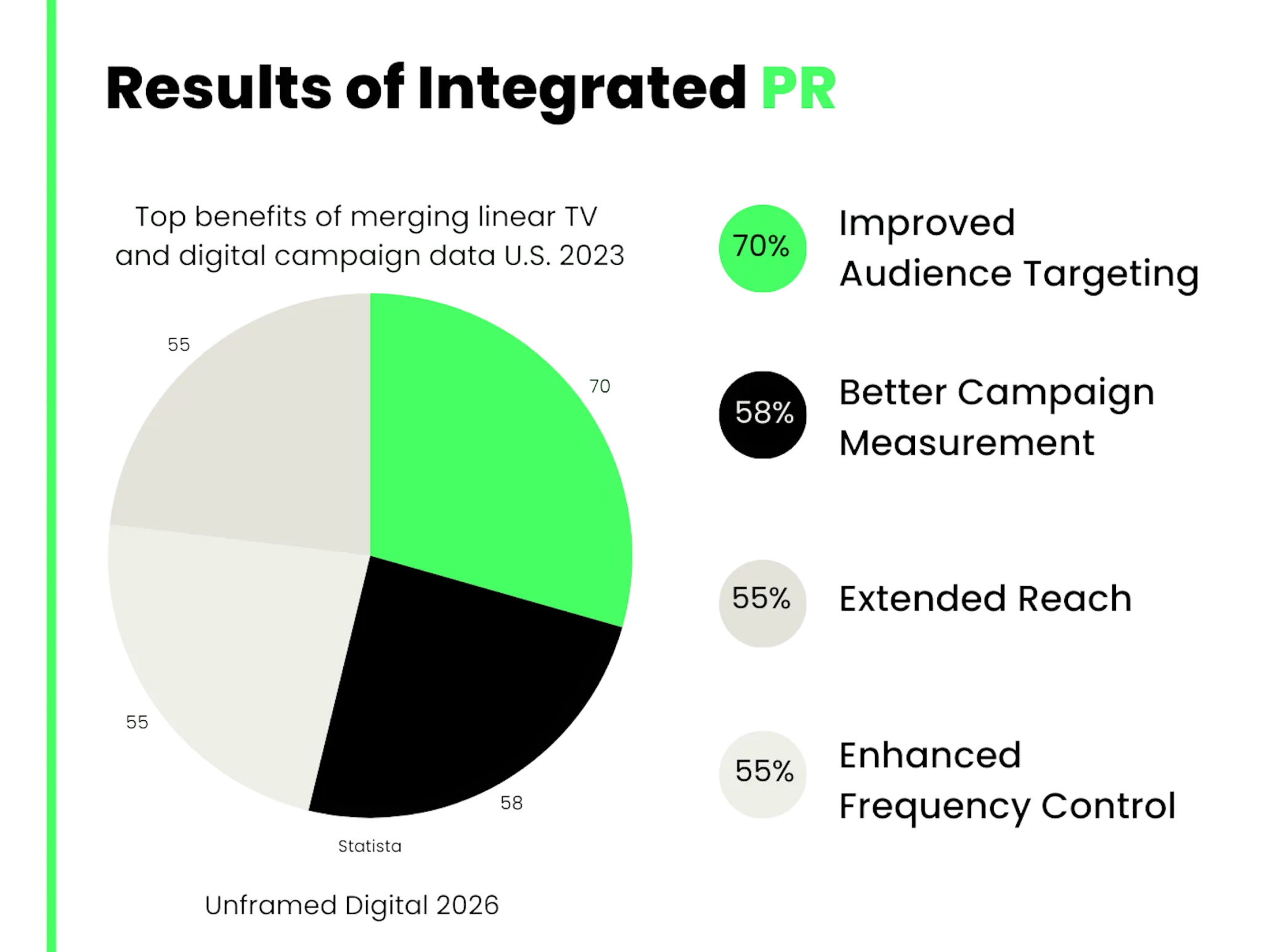
Recent data supports this integrated approach.
According to U.S. marketers, merging traditional and digital campaign data leads to:
- Improved audience targeting (70%)
- Better campaign measurement (58%)
- Extended reach (55%)
- Enhanced frequency control (55%)
Sources:
Generated by Statista Research AI
Applying This in Practice
In practice, brands that integrate both approaches tend to use traditional PR for credibility-building moments and high-stakes communication.
At the same time, they rely on Digital PR to sustain authority within search, media, and AI-driven discovery environments.
Importantly, this doesn’t mean chasing constant coverage. In fact, volume is rarely the goal. What matters is consistency, relevance, and alignment with how visibility is evaluated today.
Effective strategies focus on:
- Placing expertise where credibility already exists
- Reinforcing authority signals across related topics
- Ensuring earned media supports discoverability beyond its initial publication
Measuring Impact in a Modern PR Landscape
Measurement is another area where the difference between traditional and Digital PR becomes clear.
Traditional PR metrics often focus on estimated reach and sentiment. While useful for understanding awareness, these metrics rarely explain how visibility contributes to future discovery.
Digital PR adds additional layers of insight. Brands can track how earned media affects search rankings, referral traffic, branded queries, and citation patterns inside AI-generated responses, creating feedback loops that allow strategies to evolve over time instead of relying on assumptions.
In this way, measurement doesn’t replace storytelling—it ensures storytelling continues to support visibility where it matters most.
Choosing the Right Mix
Ultimately, there’s no universal formula.
Some organizations still lean heavily on traditional PR due to their audience, industry, or regulatory environment. Others benefit most from Digital PR because their buyers research online and evaluate credibility independently.
What matters is understanding what each approach is designed to achieve—and using them together with intent.
PR hasn’t changed because storytelling stopped mattering.
It changed because discoverability now determines which stories are seen, trusted, and remembered.
